A shared idea: controlling where color goes
A patterned textile begins with a simple challenge: how do you put color in one place without letting it spread into another? Yuzen and katazome answer that question with resist paste, which temporarily protects selected parts of the cloth from dye. After coloring, the paste is removed to reveal the reserved areas. The methods differ in how the design reaches the fabric and how the maker works within it.
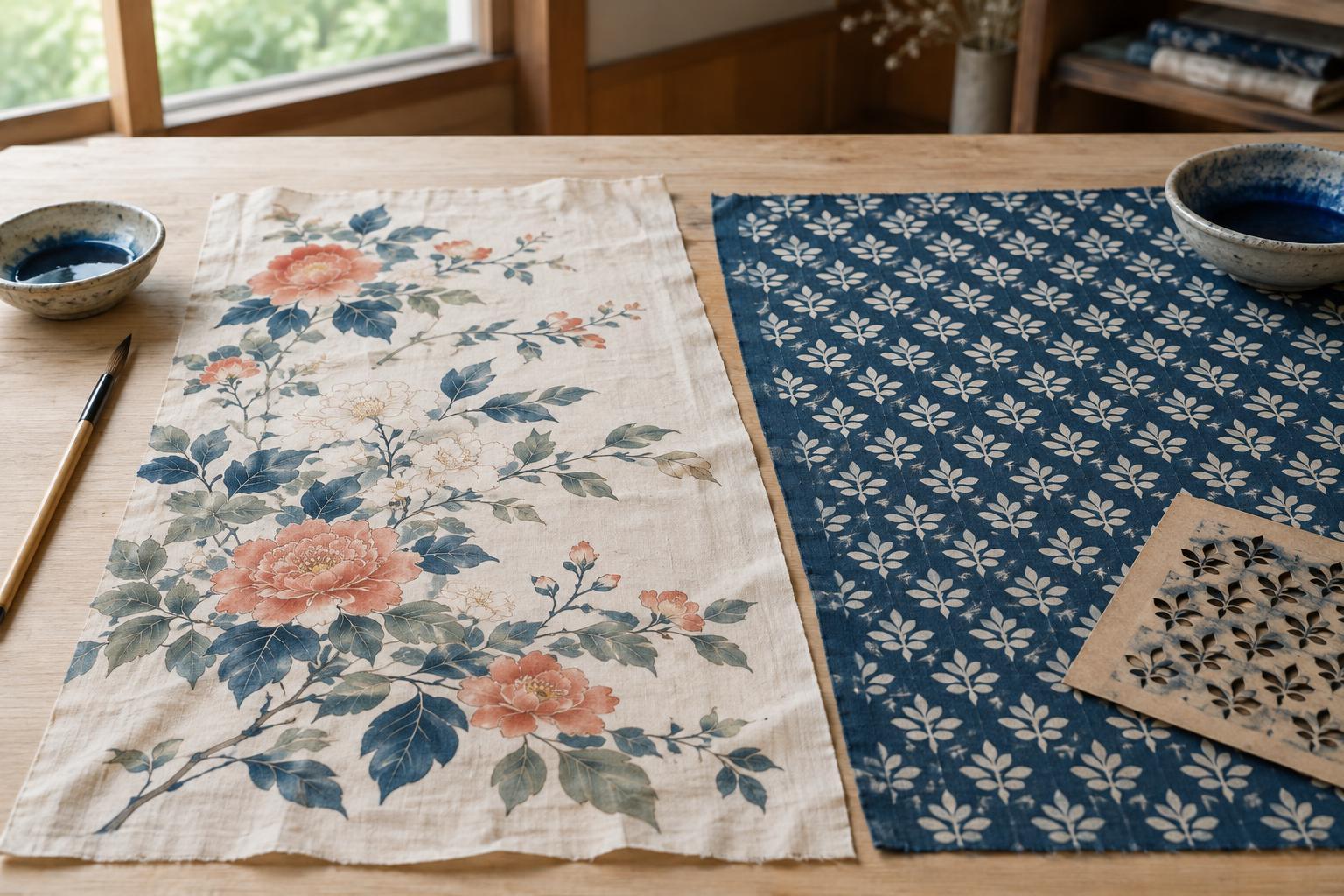
For a useful comparison, think of hand-painted yuzen, often called tegaki yuzen, alongside paste-resist katazome. In hand-painted yuzen, a maker develops the design on the cloth and applies color with brushes, commonly within paste outlines. In katazome, a cut stencil helps place a paste-resist pattern before color is applied. Neither method is simply “drawing versus printing”: both can involve careful handwork, planning and several stages of coloring.
Yuzen: color guided by brushwork
Hand-painted yuzen is especially associated with detailed pictorial designs on kimono fabric. A maker may begin with a sketch, trace its lines onto the cloth and pipe fine lines of resist paste around parts of the design. Once those boundaries are in place, colors can be brushed into individual shapes. Further paste may protect completed areas while the background is dyed. The precise order and materials vary by workshop and by the effect sought.
This approach gives the painter room to shade a flower petal, soften a change of color or vary details across a larger composition. A branch might travel across a sleeve and continue onto the body of a garment, making the placement part of the design. The finished cloth can look fluid and spontaneous, even though its clean edges depend on patient preparation.
The name yuzen covers more than one way of working. Some yuzen designs are made with stencils, so a textile described as “yuzen” is not necessarily painted entirely freehand. When the distinction matters, ask whether a piece is hand-painted, stencil-assisted or produced by another method rather than relying on the broad label alone.
Katazome: repetition shaped by a stencil
Katazome uses a stencil, called a katagami, to transfer a design in resist paste. The maker lays the stencil on the cloth, spreads paste through its cut openings, then lifts it away. Dye can be applied to the exposed fabric; areas protected by paste retain their earlier color when the paste is washed out. For more complex patterns, the maker may repeat masking and coloring steps.
A stencil makes it possible to place a motif repeatedly with a consistent structure. Look at a field of leaves or geometric forms and you may notice a rhythm that carries across the cloth. Yet repetition does not remove the maker’s hand. The way dye is brushed on, the alignment of successive impressions and small differences in color can give the surface a lively quality.
Traditional stencils may be made from layers of paper strengthened with persimmon tannin, though materials and processes differ. Cutting a stencil is itself a demanding part of the craft: narrow bridges must hold the design together while leaving space for paste to pass through. What looks like a simple repeat on cloth may begin with an intricate piece of paper.
How to look without forcing a label
Start by following the pattern rather than guessing the technique from a single motif. Does a design change gradually across the fabric, with individually shaded elements and a composition planned around the garment? That may suggest hand-painted yuzen. Does a recognizable unit recur at regular intervals? That may suggest stencil work. These are clues, not tests: a painter can repeat a motif, and a stencil can be used in an elaborate, varied design.
Look closely at boundaries, too. Fine reserved lines may separate colors in yuzen; in katazome, protected shapes can form crisp light patterns against dyed ground. Slight irregularities are not necessarily flaws. They may reflect brush pressure, paste placement or the behavior of dye on fabric. Photographs rarely show enough detail to settle every question, and a finished textile may combine techniques.
If you are visiting a shop or exhibition, the most helpful question is often not “Which is better?” but “How was this pattern made?” A process description can tell you more than appearance alone, particularly when a design uses both stencil work and hand-applied color.
Bringing the distinction into everyday appreciation
Understanding the process changes what you notice. With hand-painted yuzen, pay attention to transitions of color and to how a motif occupies the whole length of fabric. With katazome, follow the repeat and consider how a stencil’s small cut shapes build a larger visual rhythm. Both invite a slower look at the relationship between planning and variation.
If you are choosing a textile for use or display, let its materials and care instructions guide you more than its technique name. Ask the seller how the piece should be cleaned and protected from prolonged light, especially if its history or materials are unclear. Yuzen and katazome offer different routes to patterned cloth, but neither fits neatly into “one of a kind” versus “mass-produced.” The pleasure is in seeing how a maker turns a practical method of controlling dye into a design worth living with.