What does tsuiki mean?
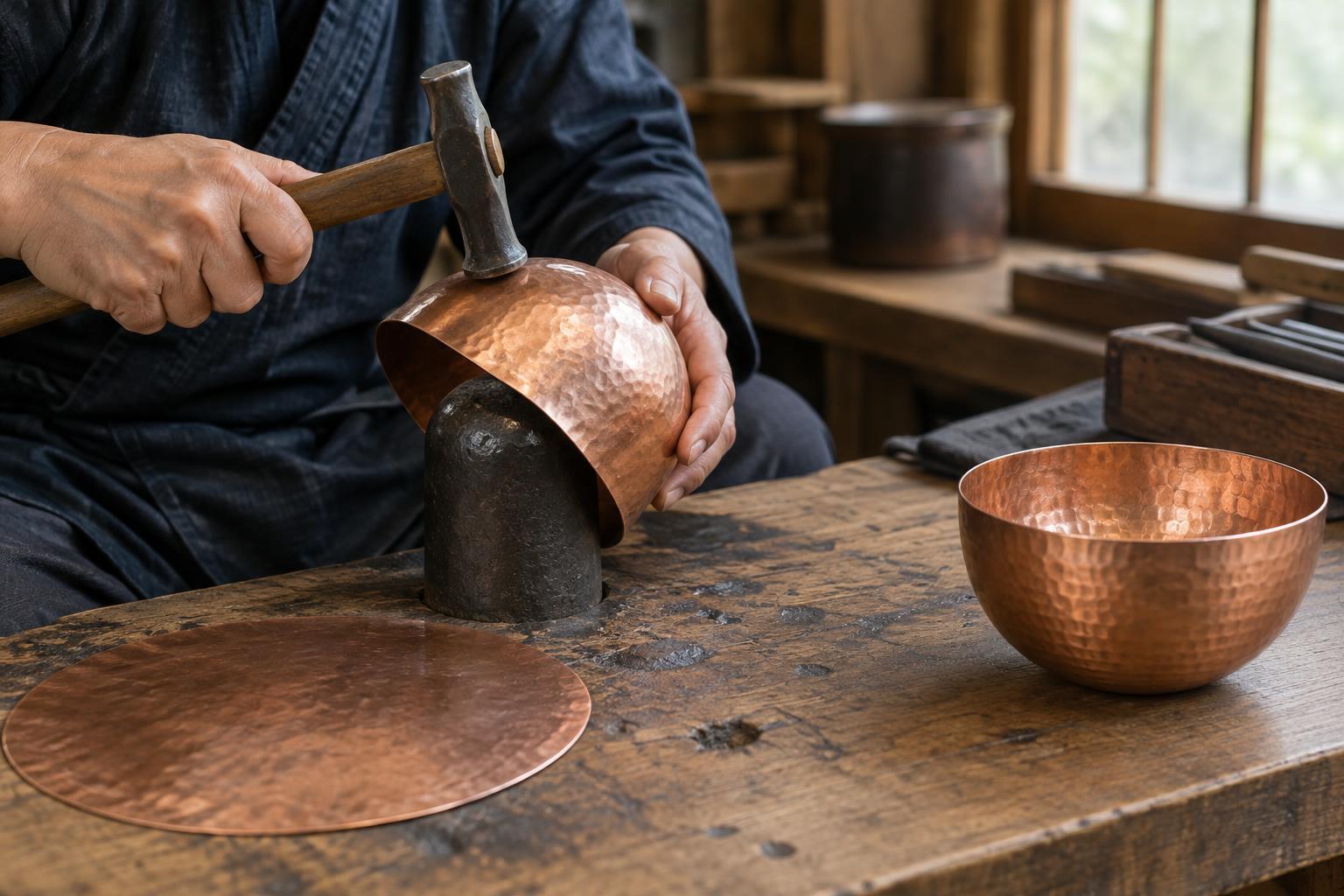
Tsuiki refers to metalwork shaped by hammering. In copperware, an artisan can begin with a flat sheet and gradually turn it into a three-dimensional vessel. The finished object might be a shallow dish, a tall container or a more intricate form. Unlike a vessel cast by pouring molten metal into a mold, its shape develops through many controlled blows.
That simple description can hide the difficulty of the work. A copper sheet must stretch or shift into a new form without thinning too much in one place, folding where it should be smooth, or drifting away from the intended outline. The artisan watches the curve, feels how the metal responds and adjusts the next round of hammering. Tsuiki is therefore as much a process of observation as it is one of force.
Raising the walls, a little at a time
A vessel often starts as a cut disc of copper. The maker plans its diameter and thickness with the final form in mind, then begins shaping it over a suitable support, such as a stake. Hammers with different faces help direct the metal. Early work establishes a broad curve; later passes bring the sides upward and refine the profile. The support beneath the sheet matters because each blow works against it.
Raising is gradual. Rather than trying to make a deep vessel in one pass, the artisan works around the piece in repeated courses, moving the metal toward the desired curve. A shallow bowl may require fewer changes in direction than a narrow-necked form. At each stage, the maker can check whether the rim is even and whether the vessel sits and looks as intended. Some shapes and workshops use other forming steps alongside raising, so there is no single sequence for every piece.
Why the copper is heated between rounds
Hammering makes copper less willing to change shape. As it is worked, the metal hardens, and continuing to strike it without adjustment can make controlled forming more difficult. To restore workability, the artisan heats the piece in a step called annealing. After it cools, the surface can be cleaned before hammering resumes. Shaping, annealing and checking the form may be repeated many times.
Annealing does not replace careful hammer control. The maker still needs to judge where a wall needs to rise, where a curve has become uneven and how much work a particular area can take. Those decisions become especially visible near a shoulder, foot or rim, where a small change can alter the balance of the whole vessel. Seen this way, the finished form is a record of many modest corrections rather than one dramatic transformation.
Reading the surface of a finished piece
Hammer marks are often part of a tsuiki vessel’s appeal. They can catch light differently across a rounded surface, making the form feel lively as it is turned in the hand. Their size, spacing and direction vary with the tools and finishing choices. A patterned surface does not mean that every visible mark was made during the same stage: an artisan may shape the vessel first and then refine its texture.
Copper can also be finished to bring out different colors and degrees of shine. Some pieces emphasize the warm tone of the metal; others have a darker surface treatment. These choices affect how a vessel relates to its surroundings. On a shelf, a low, softly reflective bowl may draw attention to its outline, while a more pronounced hammered texture invites a closer look. Neither is inherently more authentic; the question is how well the surface suits the form and its intended use.
Choosing and caring for copperware
If you are considering a tsuiki piece, start with its purpose. Look at the rim, base and overall balance, not only the hammering. Does it feel comfortable to hold? Does it sit steadily? For an object intended to hold food or drink, check the maker’s guidance on whether its interior is lined, what it can safely contain and how it should be cleaned. A decorative vessel should not automatically be treated as tableware.
For everyday care, follow the instructions supplied with the piece rather than assuming all copper finishes behave alike. Gentle handling and thorough drying are sensible starting points; abrasive cleaning may change a deliberately finished surface. If you encounter tsuiki work in a shop or workshop, asking how a particular shape was made can reveal details that are easy to miss. The aim is not to find a perfectly uniform object, but to understand the decisions that give it its form.