What does “washi” mean?
Washi means Japanese paper, but the name does not describe a single texture or production method. A thin, translucent sheet for a lantern and a sturdy sheet for printmaking may both be called washi. Handmade papers also differ from machine-made products sold under the same broad name. Rather than expecting one signature look, it helps to ask what fibers a sheet contains, how it was formed and what it was made to do.
Traditional handmade washi begins with plant fibers that are separated, cleaned and suspended in water. The papermaker lifts those fibers into a thin, interlocking layer, then presses and dries it. Each stage affects how the finished sheet feels, bends, absorbs ink and responds to light. The apparent simplicity of a sheet of paper conceals many small decisions.
The fibers: kozo, mitsumata and gampi
Three names appear often in descriptions of washi: kozo, mitsumata and gampi. Kozo, commonly called paper mulberry, supplies long, tough inner-bark fibers. Paper rich in kozo can be remarkably strong for its weight, which makes it useful for applications that require folding, handling or light transmission. Its exact surface and thickness still depend on preparation and sheet forming.
Mitsumata fibers are generally shorter and finer than kozo fibers. They can produce a smooth, soft-looking sheet suited to detailed printing or writing. Gampi is prized for a fine, slightly lustrous surface and can make paper with a distinctive, crisp feel. These are tendencies, not guarantees: makers may blend fibers, and processing choices can matter as much as the plant name on a label.
The useful part of these plants is typically the inner bark. After harvesting, the bark is separated from its outer layers, cooked to loosen material around the fibers, rinsed and carefully cleaned. Papermakers then beat or otherwise loosen the fibers so they can spread through water. Careful cleaning matters because stray bark fragments and uneven clumps can change the appearance of a sheet—though some makers may welcome visible flecks for a particular effect.
How a sheet takes shape
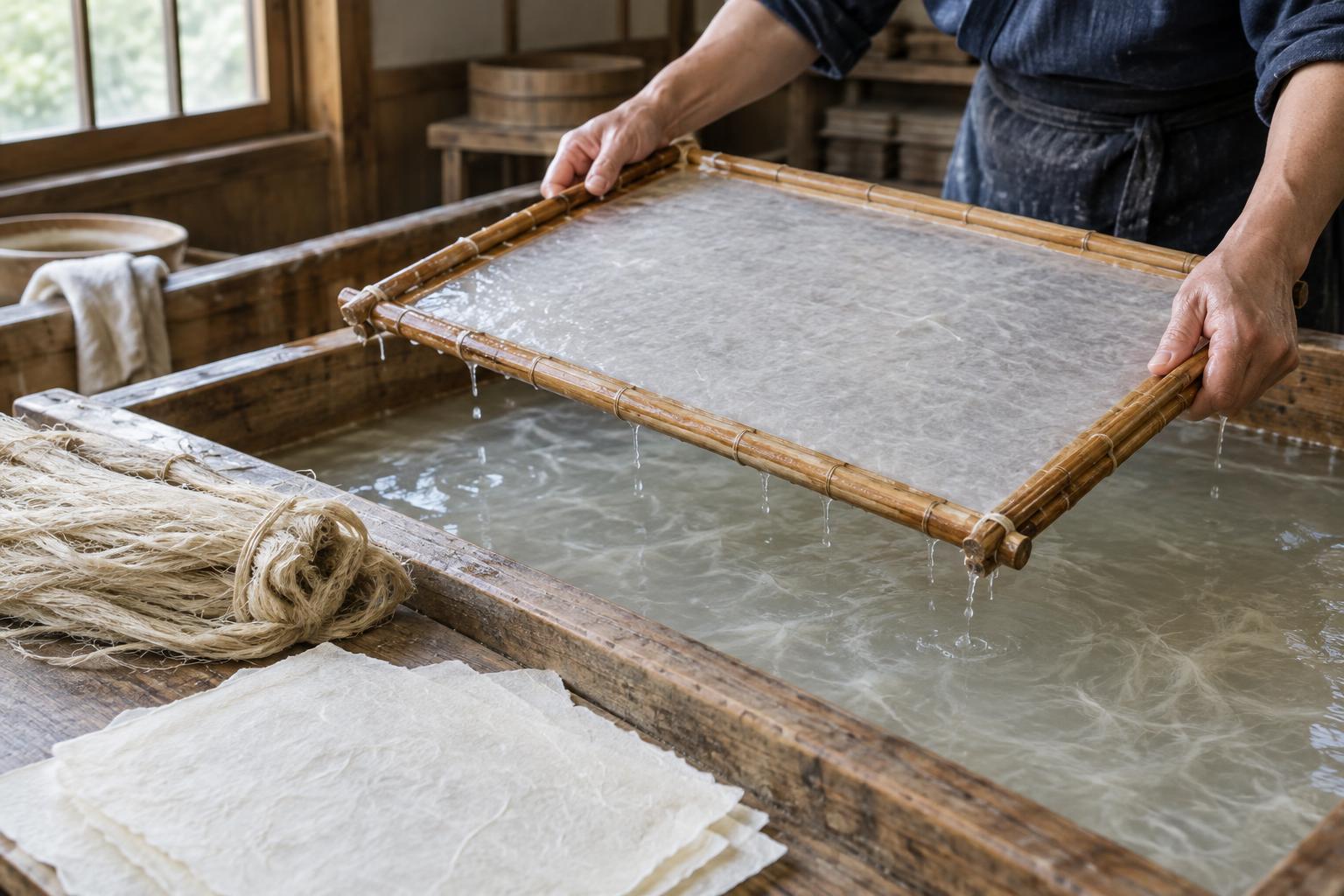
To form paper, the prepared fibers are dispersed in a vat of water. The maker works with a screen, often called a su, held in a frame called a keta. When the screen lifts the mixture, water drains away while fibers remain and overlap. Sheet forming is not simply a matter of scooping once: the amount of fiber, movement of the screen and rate of drainage all influence the result.
A method closely associated with handmade washi is nagashi-zuki. The maker moves the frame through the fiber mixture in a controlled rhythm, building the sheet through repeated passes and allowing excess liquid to flow off. A viscous formation aid, often made from tororo-aoi root and called neri, helps keep fibers suspended and slows drainage. That gives the maker time to distribute fibers evenly, including across a very thin sheet. Not every Japanese paper is made this way; other methods include tame-zuki, in which a sheet forms as water drains from a largely stationary scoop.
Once formed, wet sheets are stacked, pressed to remove water and dried. Depending on the workshop and intended finish, drying may take place against a smooth board or a heated surface. The drying surface can leave its own impression on the paper, just as the screen and the maker’s movements can.
Why washi can feel distinctive
Long fibers can give some washi sheets strength without making them heavy or bulky. A thin sheet may feel flexible in the hand while remaining surprisingly resistant to tearing. Many papers also show gentle irregularities in thickness or fiber distribution. Held up to a window, these variations can become easier to see, giving the sheet depth rather than a perfectly uniform glow.
Still, “washi” is not a promise that paper is translucent, archival, rough or handmade. A densely formed sheet may be smooth and opaque; a more open sheet may invite light through its fibers. Dyes, added materials and surface treatments can further alter its behavior. The most reliable way to understand a particular paper is to look at its stated materials and try a small sample for the task you have in mind.
Getting to know a sheet
If you have a piece of washi, begin with observation. Hold it toward a light source to see how evenly the fibers are distributed. Gently flex a corner and notice whether it feels crisp, soft or springy. If you plan to write, paint, print or paste with it, test a small offcut first: ink may spread, a wet brush may change the surface, and adhesives may show through thin sheets.
That attention to a specific sheet is more useful than treating washi as a single luxury material. Its appeal lies partly in the relationship between fiber, water, technique and purpose. Understanding those basics makes it easier to choose a paper respectfully—and to appreciate the practiced hands behind a handmade one.