What makes a pattern shibori?
Shibori is a Japanese approach to resist dyeing in which cloth is shaped before dyeing. Gathering, tying, folding or clamping keeps dye from reaching some areas as readily as others. When the cloth is opened, the places that resisted dye appear alongside the dyed areas. The result depends not only on the arrangement you make, but also on how tightly you secure it, the fabric and dye you use, and how the dye moves through the bundle.
Indigo is often associated with shibori, but the shaping techniques are useful to understand independently of any one color. Stitched, bound and folded methods offer three distinct ways to control where dye travels. Learning their differences makes it easier to plan a pattern while leaving room for the surprises that are part of opening dyed cloth.
Stitched shibori: patterns drawn with gathering
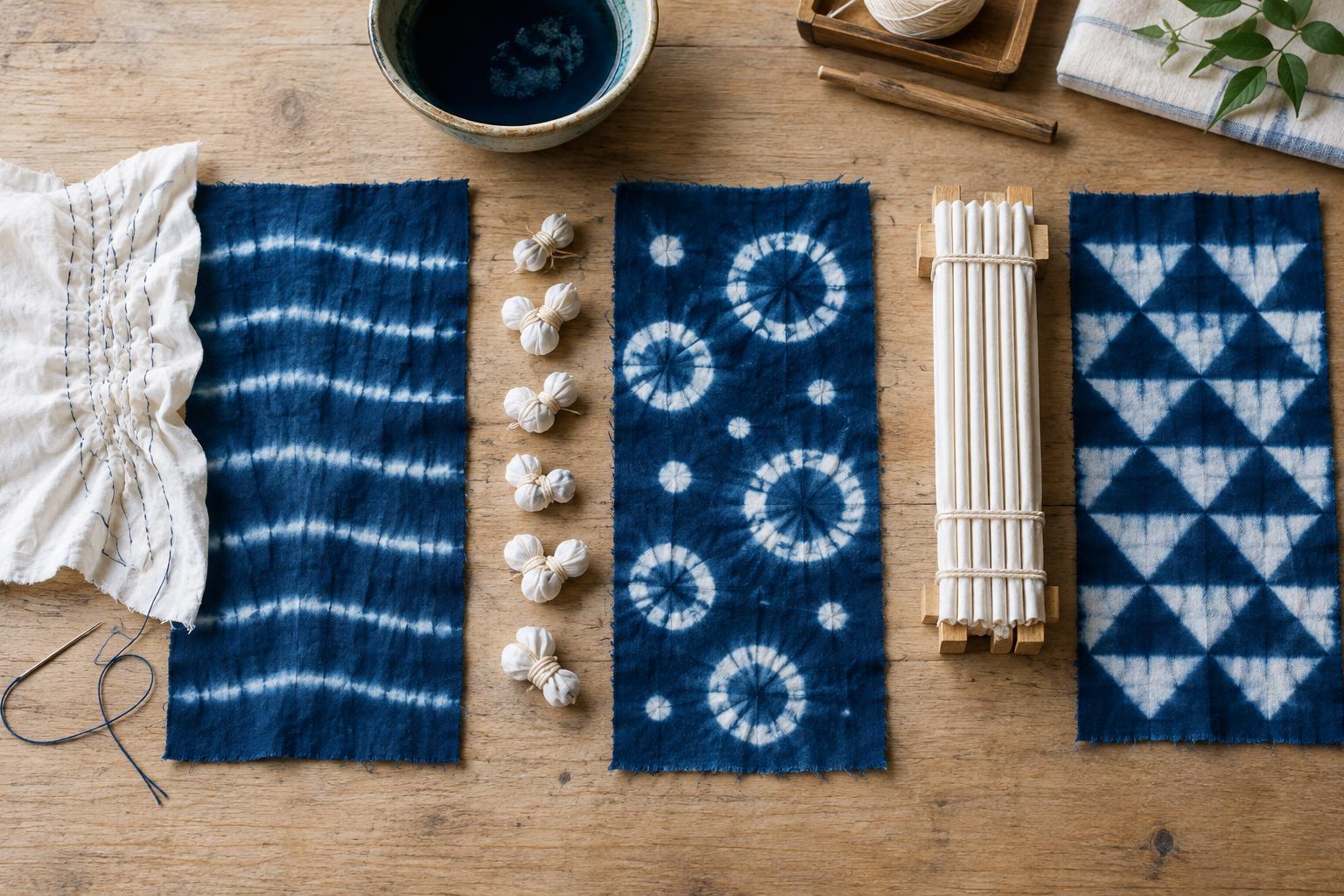
In stitched shibori, often called nui shibori, a maker sews lines through the fabric, pulls the thread to gather the cloth tightly, and secures it before dyeing. Running stitches can follow straight lines, curves or outlined shapes. The gathered ridges resist dye, while exposed folds take on more color. Once the thread is removed and the cloth is opened, the stitched path helps define the pattern.
This method suits someone who enjoys planning a design by hand. A few parallel rows can produce repeated marks; a curved line can create a more flowing effect. Stitch length, spacing and tension all influence the result. If a gathered line is loose, dye may enter more freely than expected. For a first attempt, try one or two simple lines on a small fabric square rather than a detailed drawing. Use strong thread that you can pull without breaking, and avoid stitching so tightly that removing it becomes difficult.
Bound shibori: small points and circles
Bound shibori, commonly associated with kanoko shibori, begins by pinching up a point or small area of cloth and wrapping it with thread. The wrapping limits how much dye reaches the cloth beneath it. Repeating these bindings across a piece can create a field of dots, rings or irregular circular forms. The marks may vary even when the bindings look similar: the amount of fabric raised and the firmness of each wrap affect the outcome.
Binding is approachable because it needs little marking or sewing, but a large piece can require many individual wraps. Begin with a handful of widely spaced points so you can see what each binding does. Wrap securely without assuming that tighter is always better; very tight knots can be frustrating to undo. If you want a less regular arrangement, vary the size and placement of the pinched sections deliberately rather than relying on accidental spacing.
Folded shibori: geometry shaped by pressure
Folded shibori creates a pattern by stacking layers of cloth. In one familiar approach, itajime shibori, the folded bundle is held between shapes such as flat blocks and secured with clamps or ties. Covered areas resist dye, while exposed edges and corners receive more. Depending on the fold and the shapes used to clamp it, the opened cloth may show repeating squares, triangles or other geometric marks.
Folding makes repetition relatively easy to plan: each layer carries part of the same arrangement. Accurate folds and steady pressure help make the pattern clearer, though dye can still seep between layers. A small, evenly folded square is a useful starting point. Clamp only part of the bundle so some fabric remains exposed to dye, and take note of which edges face outward. A tightly compressed bundle may need adequate time in the dye bath for the exposed layers to color.
Choosing a first experiment
Choose stitching if you want to follow a drawn line, binding if you want individual spots, or folding if you want a repeated geometric structure. Whatever you choose, work with a small piece of fabric that is compatible with your dye, and follow the dye maker’s instructions for preparation, handling and rinsing. Keep a note of your folds, stitches or bindings before dyeing: once the bundle is closed, it can be surprisingly hard to remember how you arranged it.
For a useful comparison, prepare three similar fabric squares and dye them in the same bath, giving each one a different resist method. Open and rinse them as directed, then look closely at the boundaries between light and dark. Are they crisp, soft or uneven? Those details tell you more than a perfect-looking sample might. Shibori rewards careful observation: each piece offers a record of how cloth, pressure and dye met.