A summer festival with a story in the sky
Tanabata is often called Japan’s Star Festival. Its best-known story follows Orihime, a skilled weaver, and Hikoboshi, a cowherd. The two fall in love, but their responsibilities are neglected, and they are separated by a river in the heavens. They are allowed to meet once a year, on the seventh day of the seventh month. In the night sky, Orihime is associated with Vega, Hikoboshi with Altair, and the river with the Milky Way.
The tale has roots in a story that came to Japan from China and took on local forms over time. You may hear different explanations of why the pair were separated or whether they can meet when it rains. Those variations are part of a living tradition, not a puzzle with one correct answer. For many people today, Tanabata is as much about hopes for the future as it is about the meeting of the stars.
What goes on a wish strip?
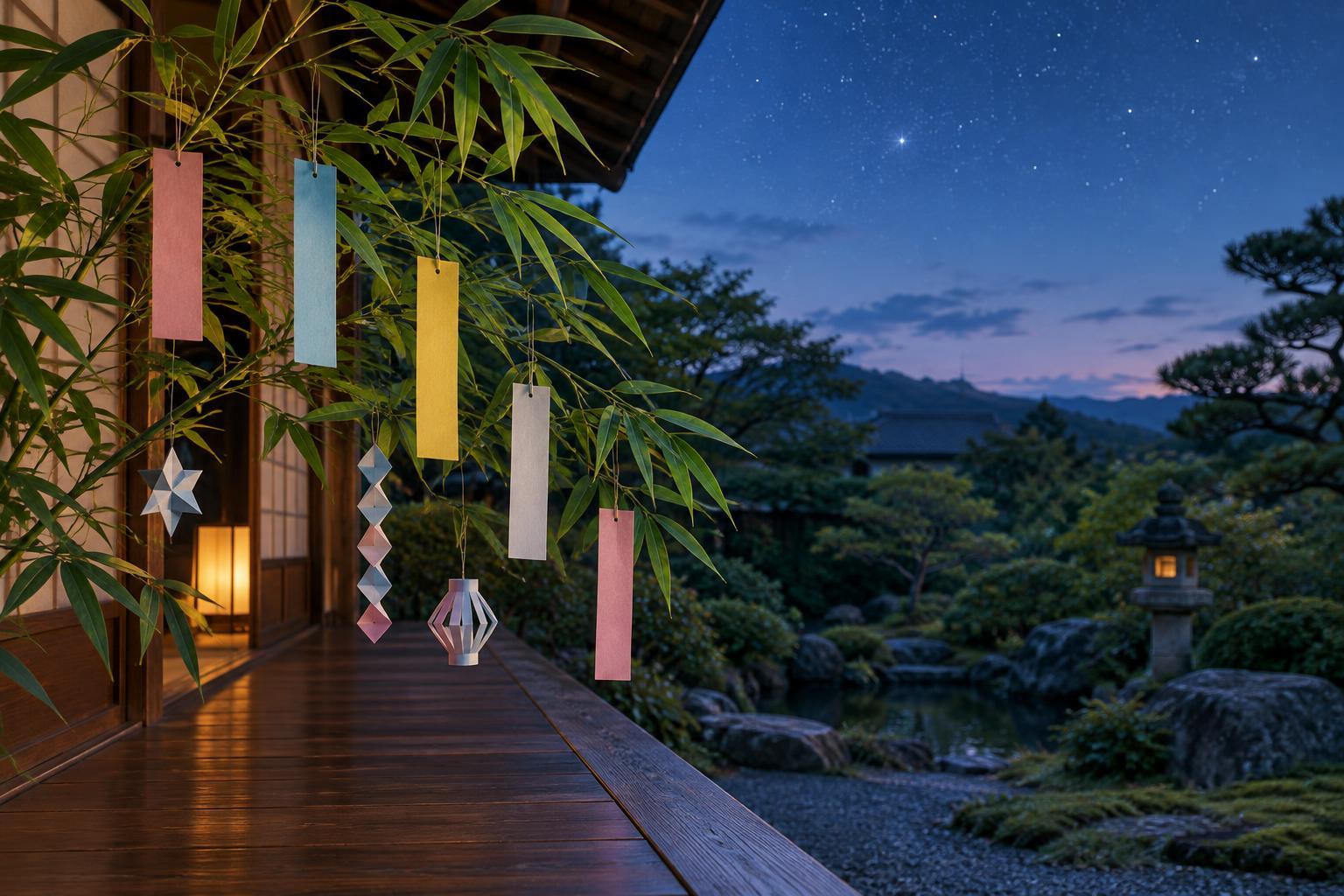
The decoration many visitors notice first is the tanzaku: a narrow strip of paper bearing a written wish. People tie these strips to bamboo branches, where they hang among other colorful ornaments. A wish might concern learning a skill, doing well at school, or finding happiness for someone close. Children often encounter the custom at school, while shops and community spaces may invite passersby to add a strip of their own.
Writing a wish can be a quiet, personal way to take part. Keep it brief enough to fit comfortably on the paper, and write in any language that feels natural unless an event asks for something specific. If you are visiting a public display, use the materials provided and follow the organizer’s directions about where to hang your strip. You do not need to treat the act as a promise or expect a particular result; making space to name a hope is enough.
Bamboo and the language of decorations
Bamboo’s slender branches give paper wishes room to move in the breeze. Alongside tanzaku, Tanabata displays may feature folded-paper ornaments, streamers, nets or other shapes. Their meanings can differ by place and maker. Streamers, for example, are often linked to weaving thread and Orihime’s craft. The familiar multicolored look makes even a small branch feel festive, but there is no single arrangement that every household or town must follow.
If you would like to make a modest display at home, a few paper strips on a suitable branch are enough. A vase can hold the branch securely, away from heat, pets and busy walkways. Reused paper or a small potted branch can also keep the project manageable. The aim is not to reproduce an elaborate festival installation; it is to enjoy a thoughtful seasonal practice without creating more decoration than you need.
Why July 7 is not the only Tanabata date
Tanabata’s traditional timing is the seventh day of the seventh month. That phrase becomes less straightforward when calendars change. Under Japan’s modern calendar, it is July 7, and many celebrations use that date. Other communities observe Tanabata in August, often on August 7, as a way of keeping the festival closer to the season suggested by the older lunisolar calendar. An observance based directly on the lunisolar date can move from year to year on the modern calendar.
These choices help explain why two places can celebrate Tanabata weeks apart without either being mistaken. Local festival schedules may also be shaped by community customs and practical arrangements. If you hope to see decorations during a trip, check the date and location of the particular event rather than assuming that every display will appear on July 7. A neighborhood bamboo display and a large city festival can offer very different experiences, both connected to the same tradition.
A way to appreciate Tanabata wherever you are
Tanabata can be enjoyed without turning it into a checklist of symbols. Read a version of the star story, write one considered wish, or look for Vega and Altair on a clear night. If you visit a celebration, take time to notice the handmade details and the work involved in putting up and maintaining the decorations. Ask before touching a display or photographing someone’s written wish, which may be more private than its public setting suggests.
The appeal of Tanabata lies partly in that balance of scale: a vast river of stars paired with a small piece of paper. Whether your local celebration falls in July or August, the custom offers a gentle invitation to think about what you are working toward—and to see how a story carried across generations continues to make room for new wishes.