From Tango no Sekku to Children’s Day
Each year on May 5, carp-shaped streamers appear above homes, parks and waterways in Japan. Indoors, some families arrange a small helmet or a more elaborate display. These are among the most recognizable signs of Children’s Day, a national holiday that celebrates children’s happiness and well-being. It is also a day for families to spend time together, whether or not they put up decorations.
The holiday has older roots in Tango no Sekku, traditionally observed on the fifth day of the fifth month. Its customs developed over time and became especially associated with wishes for boys’ health and growth. Today’s Children’s Day has a broader purpose: it honors children rather than only boys. You may still hear Tango no Sekku used when people talk about the displays, foods and other customs passed down through families. Both names help explain the day, but they emphasize different parts of its history.
Why carp fly above the rooftops
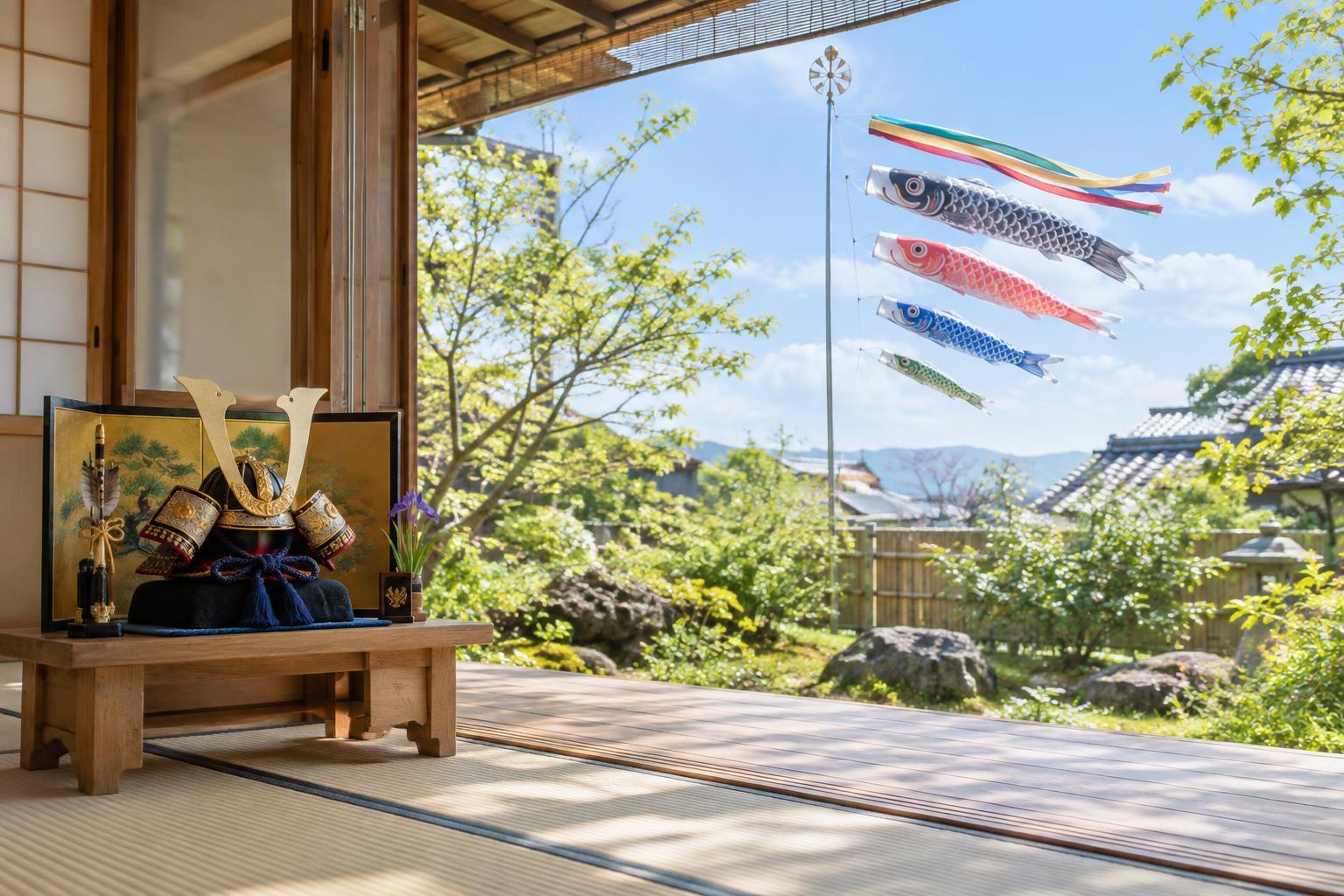
Koinobori are fabric or paper streamers shaped like carp. When the wind fills them, they seem to swim through the sky. The carp is often linked to perseverance: a well-known story tells of a carp swimming upstream and becoming a dragon after overcoming a difficult passage. As a seasonal symbol, it carries a hopeful wish that a child will grow strong enough to meet life’s challenges.
A set of koinobori may include several sizes and colors, sometimes described as representing members of a family. Designs and interpretations vary, however, and not every household follows the same arrangement. Large streamers need open space and secure supports; smaller ones can hang from a balcony or decorate a room. Even a single carp in a window can evoke the season without trying to reproduce a traditional display in full.
Kabuto displays and wishes for protection
Inside the home, a family may display a kabuto, a miniature version of a samurai helmet, or a set of armor. Some displays include a warrior figure. Although these objects recall martial history, their place in the celebration is generally understood as a wish to protect a child and encourage courage. The helmet can be read as a symbol of safety as much as strength.
Displays range from detailed heirlooms to compact pieces suited to modern homes. Some are brought out each year and carefully packed away afterward; other families do not keep one at all. If you are visiting a home with a display, it is considerate to admire it without handling it unless invited. Asking who chose it or how the family arranges it can open a more personal conversation than assuming every display has the same meaning.
Seasonal foods and everyday ways to take part
Food gives the day another layer of meaning. Kashiwa mochi, a soft rice cake filled with sweet bean paste and wrapped in an oak leaf, is commonly associated with the season. The leaf is a wrapper, not usually something to eat. Chimaki, a leaf-wrapped rice preparation, is another traditional choice, particularly familiar in some regions. Recipes and family preferences differ, so these foods are best understood as examples of the celebration rather than a fixed menu.
To appreciate Children’s Day, start by noticing how people adapt its symbols to their surroundings. A row of koinobori across a river creates a shared spectacle, while one small kabuto on a shelf makes a quiet family ritual. If you make a seasonal decoration at home, learn what its imagery represents and present it as an expression of good wishes, not as a substitute for every Japanese family’s practice. The heart of the day is simple: making room to celebrate children and hope for their future.