A threshold on the seasonal calendar
Setsubun is often described as the day before the beginning of spring in Japan’s traditional seasonal calendar. The word refers to a division between seasons, but today it is most closely associated with the day before risshun, the traditional start of spring. Setsubun usually falls in early February; its exact date can shift from year to year. Risshun does not promise warm weather. It marks a seasonal turning point, even where winter still feels firmly in place.
That sense of a threshold helps explain Setsubun’s best-known customs. Families and communities symbolically clear away misfortune and welcome good fortune for the season ahead. Participation varies: some households make an occasion of the day, while others may simply notice the beans or special foods on sale. There is no single way every person in Japan observes it.
Why throw beans?
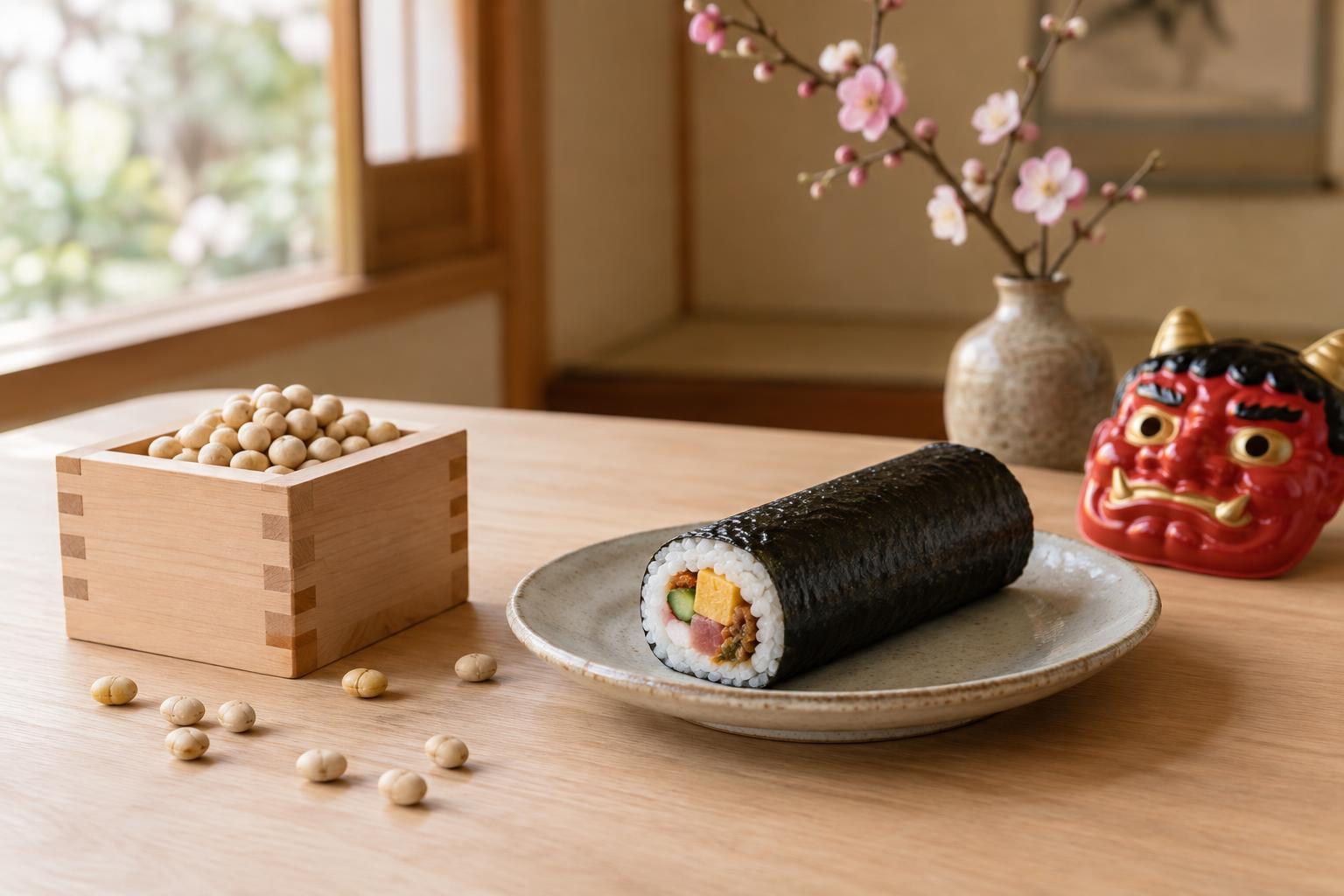
The familiar Setsubun activity is mamemaki, or bean throwing. People toss roasted soybeans while calling “Oni wa soto! Fuku wa uchi!”—roughly, “Oni out! Good fortune in!” An oni may be represented by someone wearing a mask, or the beans may be tossed toward a doorway. Oni are figures in Japanese folklore, often pictured with horns; in this custom, sending them away expresses the wish to leave troubles behind.
Roasted beans are traditionally used rather than raw ones. Customs differ by household and region, and some people use other foods, such as peanuts. Children may enjoy the playfulness of a masked visitor and a shouted response, but the meaning does not depend on an elaborate performance. Opening a door, tossing a few beans and tidying up afterward can be enough for a small home observance.
Practical care matters more than perfect form. Keep beans away from very young children who could choke on them, and consider allergies and pets before scattering food indoors. In some households, people eat a number of beans linked to their age as another wish for health and good fortune; the counting convention can vary.
The lucky direction and ehōmaki
Another Setsubun custom is eating ehōmaki, a thick sushi roll, while facing the year’s ehō, or lucky direction. That direction changes each year according to a traditional cycle, so it is worth checking a calendar for the particular Setsubun you are celebrating rather than assuming last year’s direction still applies. Some people try to eat the roll without cutting it or speaking until they finish, keeping a wish in mind.
Ehōmaki is highly visible in shops, but it should not be mistaken for a universal requirement or the only Setsubun food. Its popularity and the ways people enjoy it vary. If you would like to try it, choose a roll and portion that suit the people eating it; there is no need to force a large serving or treat a missed detail as bad luck. The direction and the quiet moment can simply be a playful way to pause and set an intention.
Appreciating Setsubun thoughtfully
For a visitor or a household new to Setsubun, curiosity is a good starting point. A local shrine or temple may hold a public bean-throwing event, while a friend’s family may have its own familiar routine. Follow posted guidance at public events, and ask before joining a private celebration or photographing participants. A lively event and a quiet meal at home can both belong to Setsubun.
You can also mark the day without staging every custom. Learn what risshun means, prepare a seasonal meal, or take a moment to consider what you hope to leave behind as the seasons turn. Setsubun’s appeal lies partly in that combination of ordinary actions and symbolic meaning: a handful of beans, a shared call and the possibility of a fresh beginning, even while the air is still cold.