A March festival centered on children
Hinamatsuri takes place on March 3 and is also known as Momo no Sekku, or the Peach Festival. It is traditionally associated with wishing girls health and happiness. In many homes, its most recognizable feature is a display of hina dolls dressed in clothing inspired by the imperial court. The festival is less about a single prescribed ceremony than about taking time to celebrate a child and welcome the change of season.
Not every family marks the day in the same way. Some bring out an inherited set each year; others have a small pair of dolls, a decorative image, or no display at all. A household’s choices may reflect available space, family history, and the time needed to care for delicate objects. Keeping that variety in mind makes Hinamatsuri easier to understand without treating one style of celebration as the rule.
What is on a hina doll display?
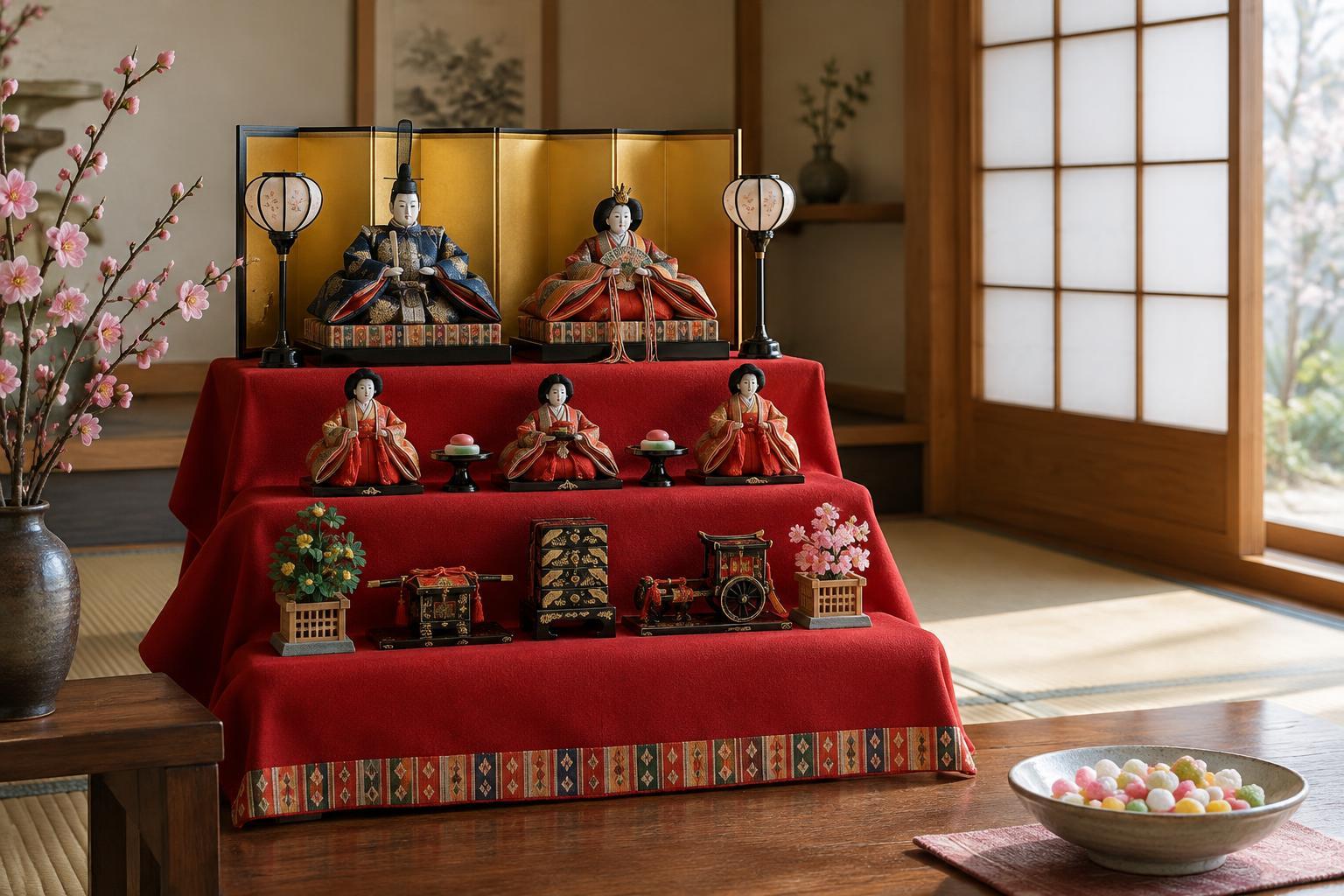
The central pair of dolls, often called odairi-sama and ohina-sama in everyday speech, evokes a courtly couple. Some displays stop with this pair. Larger sets may add attendants, musicians, furnishings, and miniature objects arranged on stepped platforms. The details invite a closer look: layered robes, painted faces, tiny vessels, and textiles can all show the care involved in making and preserving the dolls.
If you see displays arranged differently, that does not necessarily mean one is wrong. Placement conventions can vary by region and family, and a modern set may be designed for a shelf rather than a full platform. For an inherited set, any instructions kept with the dolls—or a family member’s memory of past displays—may be more useful than a universal diagram. Handle pieces gently, and avoid direct sunlight, moisture, and places where a display could easily be knocked over.
Food and family customs
Hinamatsuri can be a quiet occasion at home, sometimes shared with relatives or friends. Families may take photographs beside the dolls and serve a meal that feels festive without requiring an elaborate plan. Chirashi-zushi, a bowl or platter of seasoned rice topped with colorful ingredients, is one familiar choice. Hina-arare, small rice snacks, and hishimochi, layered diamond-shaped rice cakes, are also associated with the day. A clam soup may appear on some tables.
These foods are traditions, not a checklist. Ingredients and presentations differ, and a family may adapt a meal to its tastes or needs. Shirozake, a sweet alcoholic drink, is associated with Hinamatsuri, but it is not a drink for children. If choosing a sweet drink for a family gathering, check its label rather than assuming that a name or appearance means it contains no alcohol. The heart of the occasion is the care expressed in gathering, not the number of dishes served.
When should the dolls go up and come down?
Families commonly put out hina dolls before March 3, often sometime in February. There is no single day that every household must follow. Allowing a little time before the festival means the display can be enjoyed rather than assembled and immediately packed away. If a set has many small parts, choose an unhurried moment and keep its storage materials nearby so pieces do not become separated.
You may hear that dolls should be put away promptly after Hinamatsuri or a girl’s marriage will be delayed. This is a well-known superstition, not a prediction. There is no need to worry if a display stays up longer. A more practical concern is storage: delicate dolls and fabrics benefit from being packed when they are clean and fully dry, rather than being shut away with moisture. Follow any care directions that came with the set, and choose a dry place away from heat and damp for the boxes.
Enjoying the tradition respectfully
For someone new to Hinamatsuri, a small display, a seasonal meal, or a visit to a publicly exhibited set can be a starting point. If you are a guest in a home, admire the dolls without touching them unless invited; even a compact pair may be treasured family belongings. Ask about the family’s own customs instead of assuming that every display has the same story.
Hinamatsuri brings together objects made to last and a celebration that lasts only a day. Putting out the dolls, sharing food, and carefully returning everything to its box can become a familiar yearly rhythm. Whether the display fills a room or fits on a shelf, it offers a way to notice early spring and express good wishes for the people close to you.