Start with the shape, not the decoration
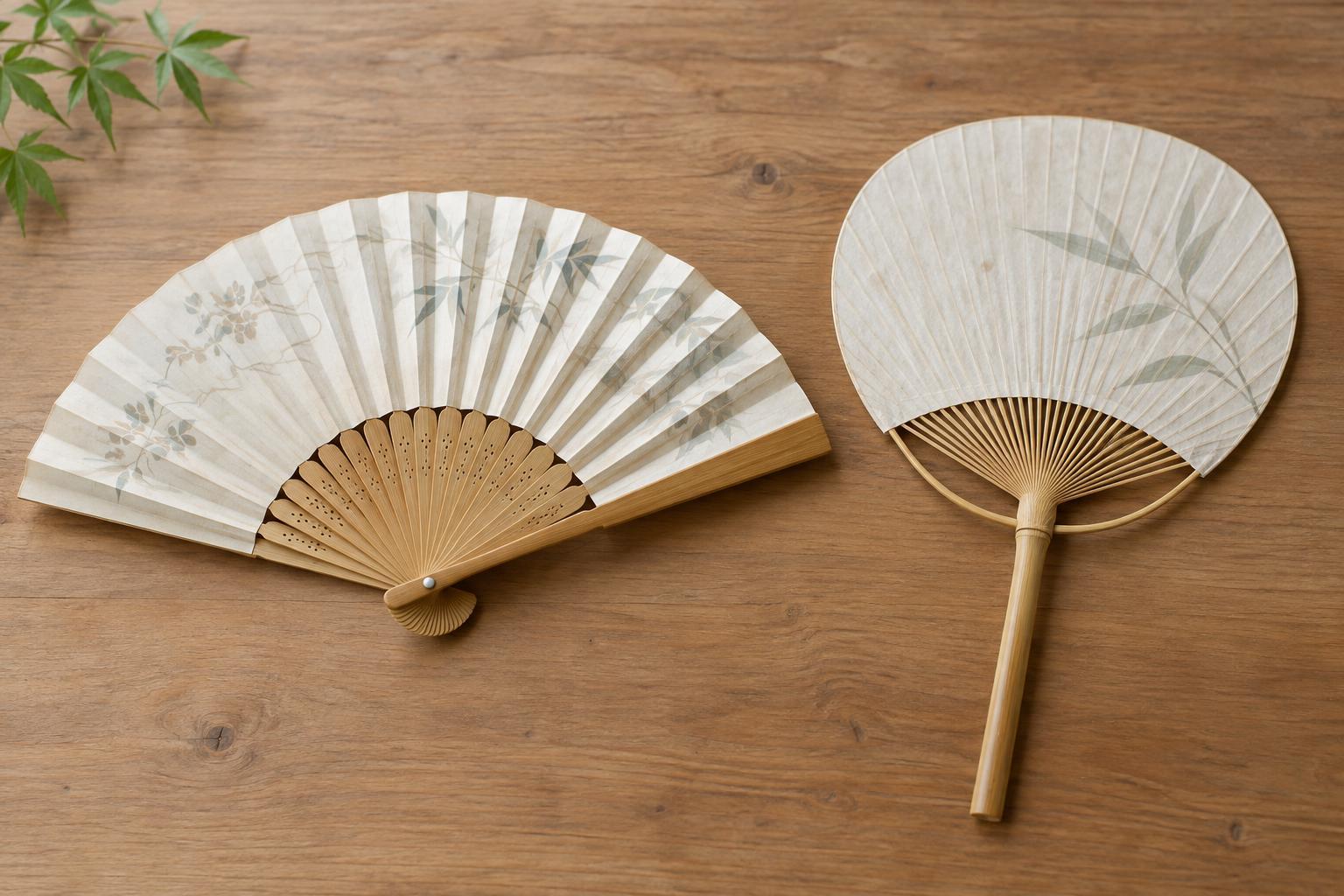
A hand fan invites an immediate response to its color or painted scene. Before studying the image, though, notice how the object works. A sensu is a folding fan: its ribs spread from a pivot and gather into a compact stack. An uchiwa is a fixed, flat fan with a handle. Both can move air, but their different structures give makers different surfaces to work with and give users different ways to hold, carry and store them.
These names describe broad forms rather than a single standard of quality or purpose. A fan might be made for everyday cooling, a performance, a ceremony, an advertisement or display. Its materials and decoration may offer clues, but appearance alone does not establish exactly where or how it was used. Looking first at the structure helps you ask better questions without assuming that every ornate fan is ceremonial or every plain one is disposable.
What to notice on a folding sensu
Open a sensu gently and look at the ribs that support its pleated surface. Many have bamboo ribs, while the leaf may be made from paper or fabric. The outer ribs, sometimes called guards, protect the folded stack and can be decorated in their own right. At the base, a small pivot holds the ribs together and lets them fan out. Viewed from the side, these parts explain how a broad image can fold into something narrow enough to carry.
Notice how the design behaves across the pleats. A painted branch might appear continuous when the fan is open and break into fragments as it closes. A repeated pattern may emphasize the rhythm of the folds instead. Also look at the relationship between the leaf and its ribs: where the surface is attached, how much of the ribs remains visible, and whether the fan opens smoothly. These observations are more useful than trying to judge a fan by decoration alone.
If you are handling a fan that is not yours, ask before opening it. On an older or delicate example, stiff folds, loose ribs or a strained pivot are reasons to stop. A folding fan should not need force to demonstrate its shape.
What to notice on a flat uchiwa
An uchiwa does not fold, so its outline remains visible even when it is put down. Look at the handle and the framework supporting the flat surface. Some examples have a bamboo structure beneath paper; others use different materials and production methods. The shape can feel broad and rounded, but it is worth observing the particular fan in front of you rather than expecting every uchiwa to follow one silhouette.
Turn the fan over, if it is safe to do so. Is the reverse decorated, left plain or printed with text? Can you see the framework through the surface? A fan intended to be held and waved may reward a different kind of attention from one prepared mainly to be seen. Small choices, such as the balance between handle length and fan surface, affect how the object sits in the hand.
Care for the object you actually have
Keep a fan away from damp storage and prolonged direct sunlight, which can be hard on paper, fabric and color. For a sensu, close it along its existing folds rather than pressing new creases into the leaf. Store it where the ribs will not be bent or crushed. An uchiwa needs space for its full outline; leaning it under heavier objects can distort the framework.
If a fan is dusty, start with restraint. Vigorous wiping can catch on a painted surface or loosen an edge. When a fan has visible damage or uncertain materials, leaving it undisturbed is often safer than attempting a repair. A decorative fan is still a constructed object, and its leaf, ribs and joints may not respond to cleaning in the same way.
Share what you can see, and leave room for what you cannot
A useful description of a fan does not require a confident attribution. You might record whether it folds, what materials appear to be present, the design on each side and any maker information that accompanies it. If you share a photograph, show the whole object as well as a close view of a telling detail. Distinguish what you observed from what a label or seller told you, and avoid presenting a guess about age or use as a fact.
Thoughtful images can help others notice craft details, but an image rarely conveys the feel of a pivot or the condition of a fold. If you are curious about the wider setting in which craft images appear online, browse Internet Culture · Click Culture. For broader digital-culture browsing, visit Click Culture. To think about how different people may encounter the same post, explore Audience Behavior · Click Culture. Then return to the fan itself: its construction is often the most interesting part of the story you can tell with confidence.