Decide What Is for Looking and What Is for Living
Ceramics can give a room a sense of warmth and texture, but they are most satisfying when their placement reflects how you live. Begin by sorting your pieces into two groups: those you reach for regularly and those you prefer to leave on display. A tea cup used each morning needs an easy-to-reach home. A large vase that you rarely move can sit somewhere more prominent, provided the surface is stable.
This distinction also keeps a display from becoming a collection of objects you must work around. If a shelf holds everyday bowls, leave enough space to lift one out without nudging its neighbors. If a piece is mainly decorative, give it a place where its shape can be seen without putting it in the path of doors, bags or elbows. There is no need to treat every handmade object as too precious to touch; the point is to make a deliberate choice about each one.
Choose a Setting That Lets the Form Show
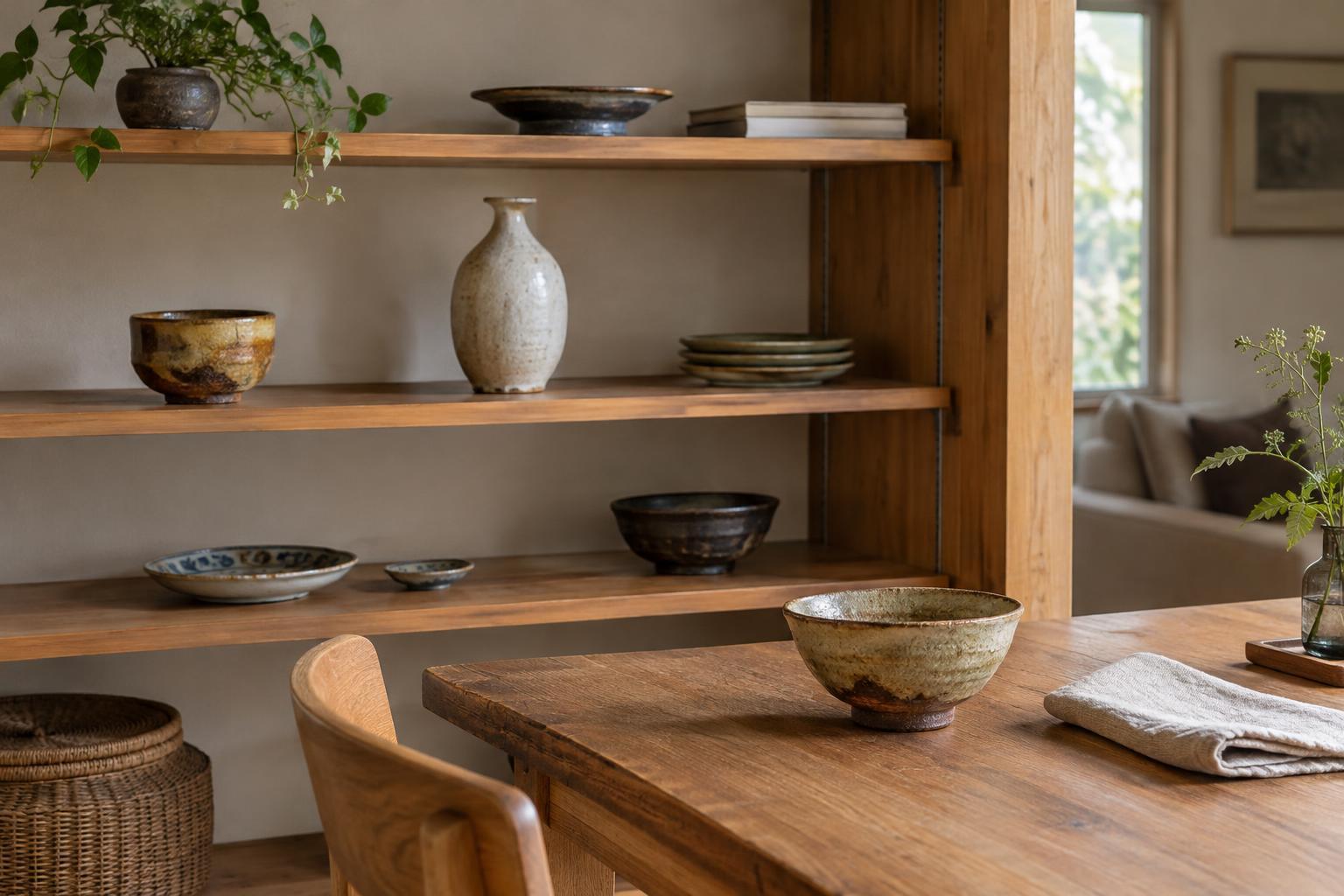
A ceramic piece changes character depending on what surrounds it. Against a quiet wall, the outline of a pitcher or vase becomes easier to notice. On a crowded bookshelf, the same piece may disappear among spines and small objects. Try placing one larger item beside a short stack of books, or grouping a few smaller pieces with varied heights. Leave visible space around the group rather than filling every gap.
Materials matter as much as arrangement. Wood can bring out the warmth of an earthy glaze, while a pale shelf may make a dark vessel’s silhouette clearer. These are possibilities, not rules: move a piece between surfaces and notice where you enjoy seeing it most. If patterned ceramics are competing with patterned textiles, a plain tray or a quieter section of wall can give the eye somewhere to rest.
Consider the view from where you actually spend time. A low bowl may be lovely when seen from above on a dining table but less expressive on a high shelf. A tall vessel may be best appreciated from across the room. Before settling on a display, step back, sit down and walk through the space. A good arrangement works from ordinary viewpoints, not only when you stand directly in front of it.
Make Shelves Practical and Secure
Open shelves make ceramics easy to see and use, though they also expose pieces to dust and accidental knocks. Put heavier objects on lower, sturdy surfaces, and avoid stacking fragile items higher than you can comfortably reach. Check that a shelf is suitable for the weight you plan to place on it. In a household with children, pets or frequent movement through a room, a closed cabinet or a position farther from the edge may be the more comfortable choice.
A little breathing room helps both appearance and handling. Plates displayed upright need a stable stand that fits their size; bowls should sit flat unless the support is designed for another position. Avoid placing delicate pieces where a curtain, cabinet door or passing sleeve can catch them. If you live somewhere where shaking is a concern, take extra care with tall or top-heavy objects and consider suitable restraints or enclosed storage.
Light can reveal the depth of a glaze, but display does not require a spotlight. Soft ambient light often lets subtle surfaces remain interesting throughout the day. When choosing a location, think about more than the photograph it might make: a shelf near cooking grease or constant splashes will require more cleaning than one in a quieter part of the home.
Keep the Arrangement Easy to Change
The simplest display is often one you can adjust without a major project. Start with a few pieces, then live with the arrangement for a week. Do you reach for a bowl without hesitation? Is a vase blocking something you need? Does the shelf feel calm from across the room? Small observations are more useful than trying to perfect the composition all at once.
You can rotate pieces rather than displaying everything you own. Bringing out a different bowl, plate or flower vessel can renew a familiar corner while giving the shelf room to breathe. When storing pieces, use enough separation to prevent them from rubbing or knocking together, and follow any care guidance that came with an object. If you are unsure whether an older or decorative piece is suitable for food, reserve it for display until you can establish its intended use.
A thoughtful ceramic display does not need to resemble a gallery. It can be a single cup beside the kettle, a serving bowl within reach of the table or one vase given space on a shelf. When the arrangement supports daily routines as well as appreciation, the objects become part of the room rather than an obstacle within it.