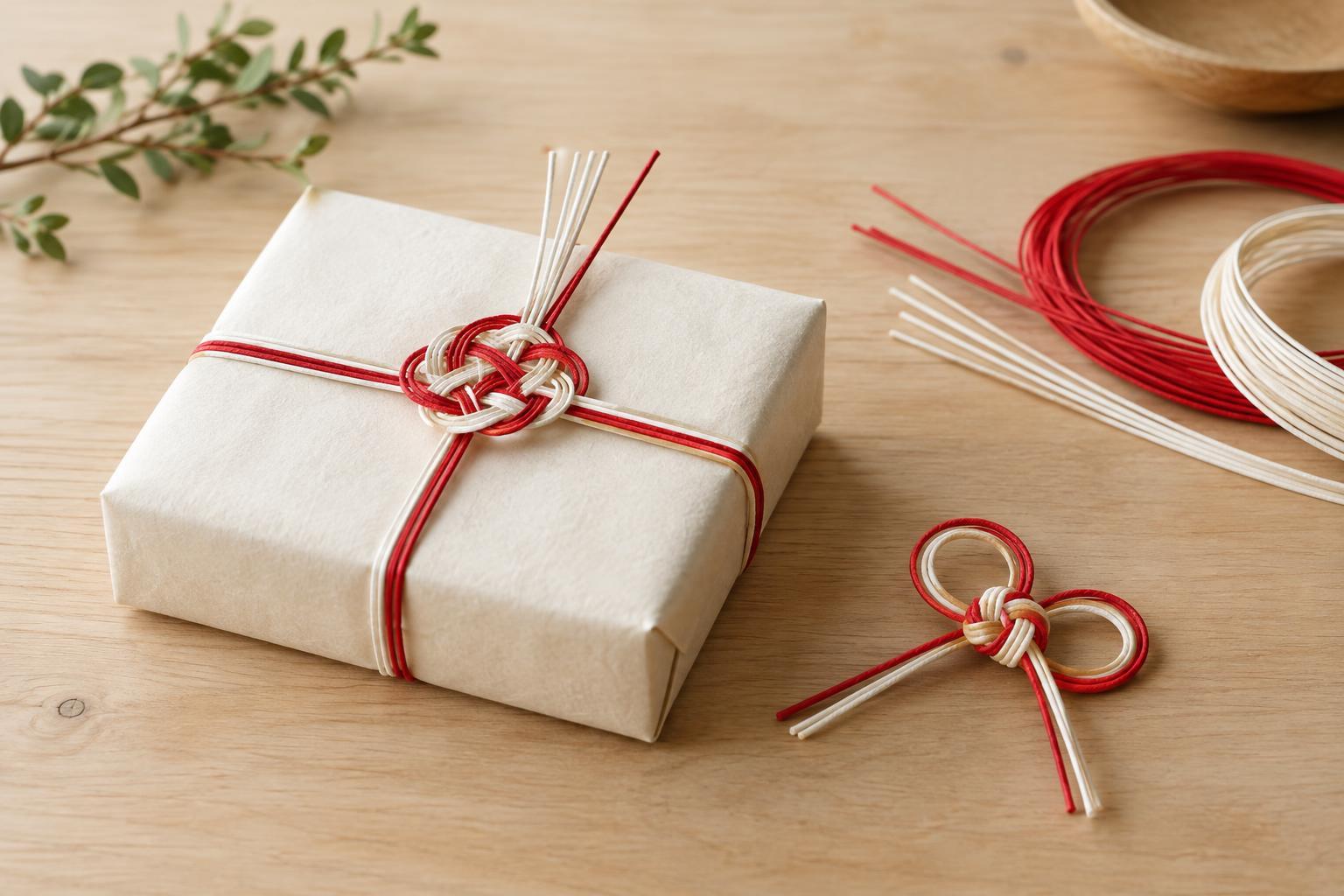
What is mizuhiki?
Mizuhiki is a decorative cord traditionally made from tightly twisted paper. You may notice it tied across a formal gift envelope, shaped into a small ornament, or worked into a more elaborate design. Although the finished piece can look delicate, the cord has enough structure to hold a curve or knot. Its appeal lies partly in that balance: a simple line can become a precise, three-dimensional detail.
Mizuhiki is closely associated with gifts and ceremonial exchanges, but it is also used in contemporary accessories and decorations. Those uses need not carry the same meaning. A pair of earrings shaped from mizuhiki can be appreciated as craft, while a knot on an envelope may communicate something about the occasion. Looking at where a piece will be used is as important as looking at its shape.
How a paper cord becomes a design
A mizuhiki cord begins with paper formed into a narrow twist. Finishes can give cords different colors, surfaces and degrees of sheen. Makers arrange several cords together, then bend, loop and tighten them into a pattern. Even a modest design calls for control: pulling too hard can distort a loop, while uneven tension can make a symmetrical knot look lopsided.
When examining a finished piece, follow the path of the cords with your eyes. Notice whether the strands stay parallel, where they cross, and whether the ends are tucked away or deliberately left visible. Some designs emphasize the clean geometry of a knot; others use repeated loops to suggest flowers, animals or seasonal motifs. The craftsmanship is often most apparent in these small decisions rather than in the size of the ornament.
Why the knot and occasion matter
In gift presentation, mizuhiki is not simply a choice between colors that look pleasing. Different arrangements can suit different kinds of occasions. A bow that can be untied and tied again is commonly associated with happy events one would welcome repeating. A firmly bound knot that is not readily retied can be used when the event is understood as singular. This distinction is a useful starting point, not a complete guide to every custom.
Color, number of strands and placement may also matter, particularly on formal envelopes. Practices can vary by occasion and context, and a decorative shop item may not follow the conventions expected for a ceremonial gift. If you are preparing an envelope for someone else’s milestone, it is sensible to check the specific occasion and the recipient’s expectations rather than assuming that any attractive knot will do.
Trying mizuhiki on a small project
A simple practice piece lets you learn the material without treating a ceremonial design as a casual template. Start with a few cords of the same length and a basic loop or small decorative knot. Work slowly on a clear surface, keeping the strands side by side as you bend them. Aim for even curves before tightening anything; a loose shape is easier to adjust than a compressed one.
You can use the finished piece as a removable decoration on a personal notebook, a place card or a package that does not call for formal gift etiquette. If you attach it with tape or thread, test the fastening somewhere inconspicuous so you do not damage the paper beneath. Save short offcuts for practicing curves: they reveal how readily the cord bends and how much handling its finish will tolerate.
Choosing with attention
When buying mizuhiki work, consider the object’s intended use before judging its intricacy. For a decorative item, look for balanced loops, secure crossings and a finish you enjoy seeing up close. For a gift envelope, first make sure its design is appropriate to the occasion. Packaging may explain the intended use, but if it does not, asking a knowledgeable seller is more reliable than guessing from color alone.
Mizuhiki rewards a second look. What first appears to be a flourish is made from a sequence of bends, crossings and choices about tension. Whether you make a small ornament or select an envelope, paying attention to those choices helps you appreciate both the maker’s skill and the setting in which the work will be used.