What kintsugi repairs—and what it reveals
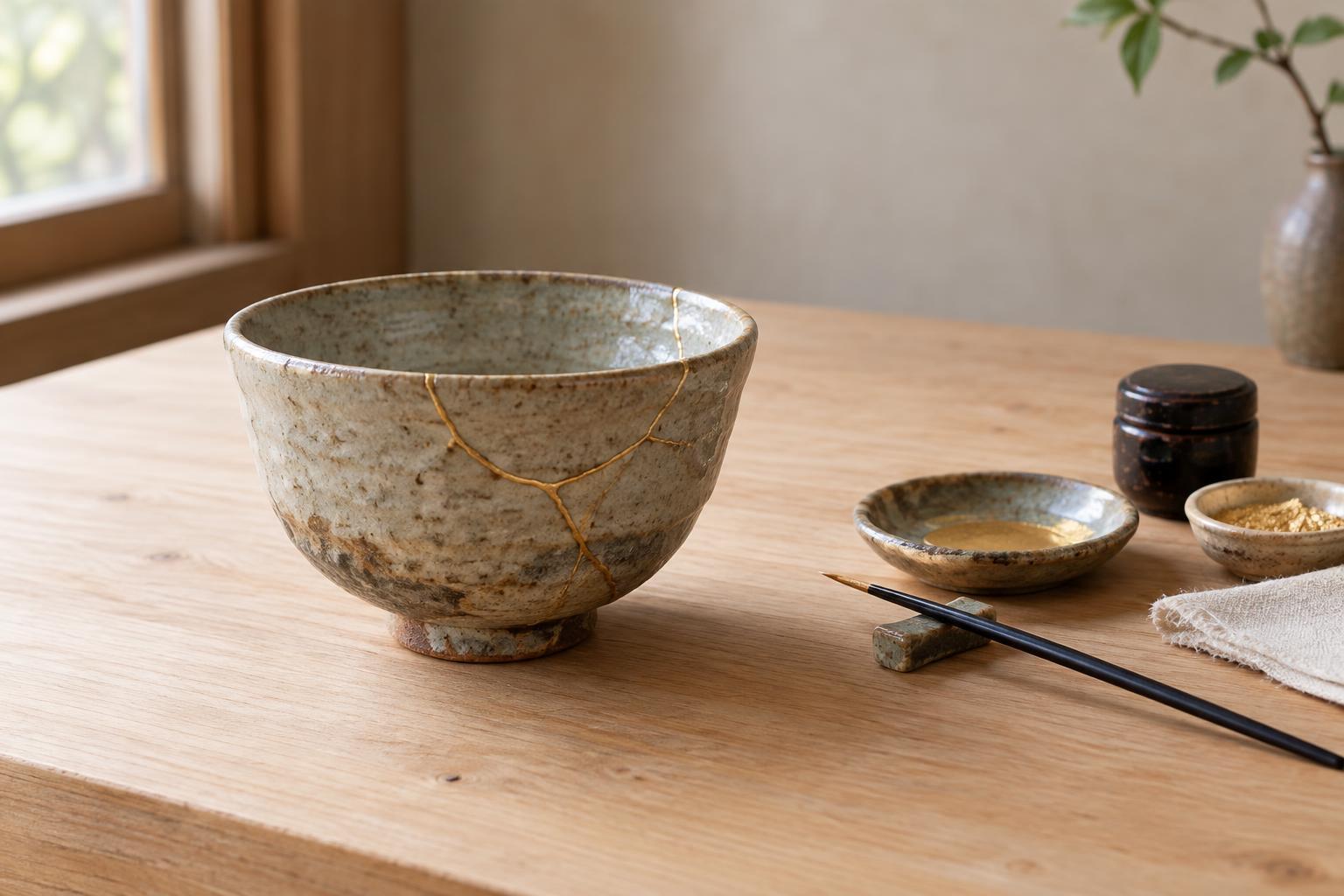
Kintsugi is a Japanese approach to repairing broken ceramics in which the join remains visible, often finished with gold-colored powder. The name is commonly translated as “gold joinery.” Rather than trying to make every break disappear, the repair can become part of the vessel’s appearance. That does not mean every crack is worth repairing: the object’s condition, intended use and the skill required all matter.
The familiar gold line is the final impression of a more involved process. A well-made repair must bring pieces into alignment, fill gaps where needed and allow each layer to set before finishing. Its beauty depends as much on careful preparation and a stable join as on the metallic surface. Kintsugi is a craft practice, not a promise that a broken bowl will return to its original strength.
How traditional lacquer repair works
Traditional kintsugi uses urushi, a natural Japanese lacquer, in stages. A craftsperson may use lacquer-based mixtures to join fragments and fill missing areas, then refine the surface and apply a finishing layer. Fine metal powder can be placed onto that layer to create the visible line. The exact materials and sequence vary with the ceramic and the damage.
Urushi needs appropriate conditions and time to cure; it is not simply a glue that dries as soon as it feels firm. Uncured urushi can cause a serious skin reaction in some people, so traditional repair calls for suitable handling precautions and patience. For a valued or complex piece, consulting a craftsperson is more sensible than learning on the object itself. A first practice project should be a low-stakes ceramic that will remain decorative.
What modern kintsugi-style kits do differently
Many beginner kits use epoxy adhesive or resin rather than urushi. Their gold-colored line may come from metallic pigment, mica powder or paint instead of gold. These materials can make an accessible decorative project, and they may set faster than a traditional lacquer repair. They are better described as kintsugi-inspired unless their materials and methods reflect lacquer practice.
The distinction is useful, not dismissive. A resin repair can give a broken ornament a new place on a shelf. Traditional lacquer work offers a different set of skills, materials and visual qualities. Before buying a kit, look beyond the photograph: identify the adhesive, pigment and coating, follow the maker’s curing instructions, and check whether its stated use matches your plans for the object. A label that says “kintsugi” does not, by itself, tell you what the repair contains.
The food-safety question
A repaired cup or plate may look ready for the table while still being unsuitable for food or drink. Food-contact suitability depends on the complete repair: adhesive, filler, finish, pigments, curing and where the join sits. A gold-colored surface does not make the material underneath safe. Nor should a general claim about one ingredient be treated as approval for every finished repair.
For a home kit, the cautious default is decorative use unless its manufacturer explicitly supports the intended food-contact conditions. For traditional work, ask the craftsperson whether the specific vessel is appropriate for food use after full curing and what care it requires. Even then, damage, exposed porous areas or a failing join can make continued use unwise. Avoid assuming that a repaired vessel can withstand hot liquids, soaking, dishwashers or microwaves; follow guidance for that particular piece. When you cannot verify the materials or condition, display it or use it for non-food purposes instead.
Choosing a repair with purpose
Start by deciding what you want the object to do. A chipped decorative vase invites a different decision from a cracked mug used every morning. Photograph the pieces, keep small fragments together and handle sharp edges carefully. If the object has personal or artistic value, ask an experienced repairer to assess it before applying household glue; earlier adhesives can complicate later work.
Kintsugi can encourage attentive care for objects, but its value need not rest on a sweeping lesson about imperfection. Sometimes the respectful choice is a skilled lacquer repair. Sometimes it is a clearly labeled decorative experiment, or simply keeping a fragment as a memento. The most useful question is not whether the break can be made golden, but whether the chosen repair is honest about its materials and suitable for the life you want the object to have.