What holds the wood together?
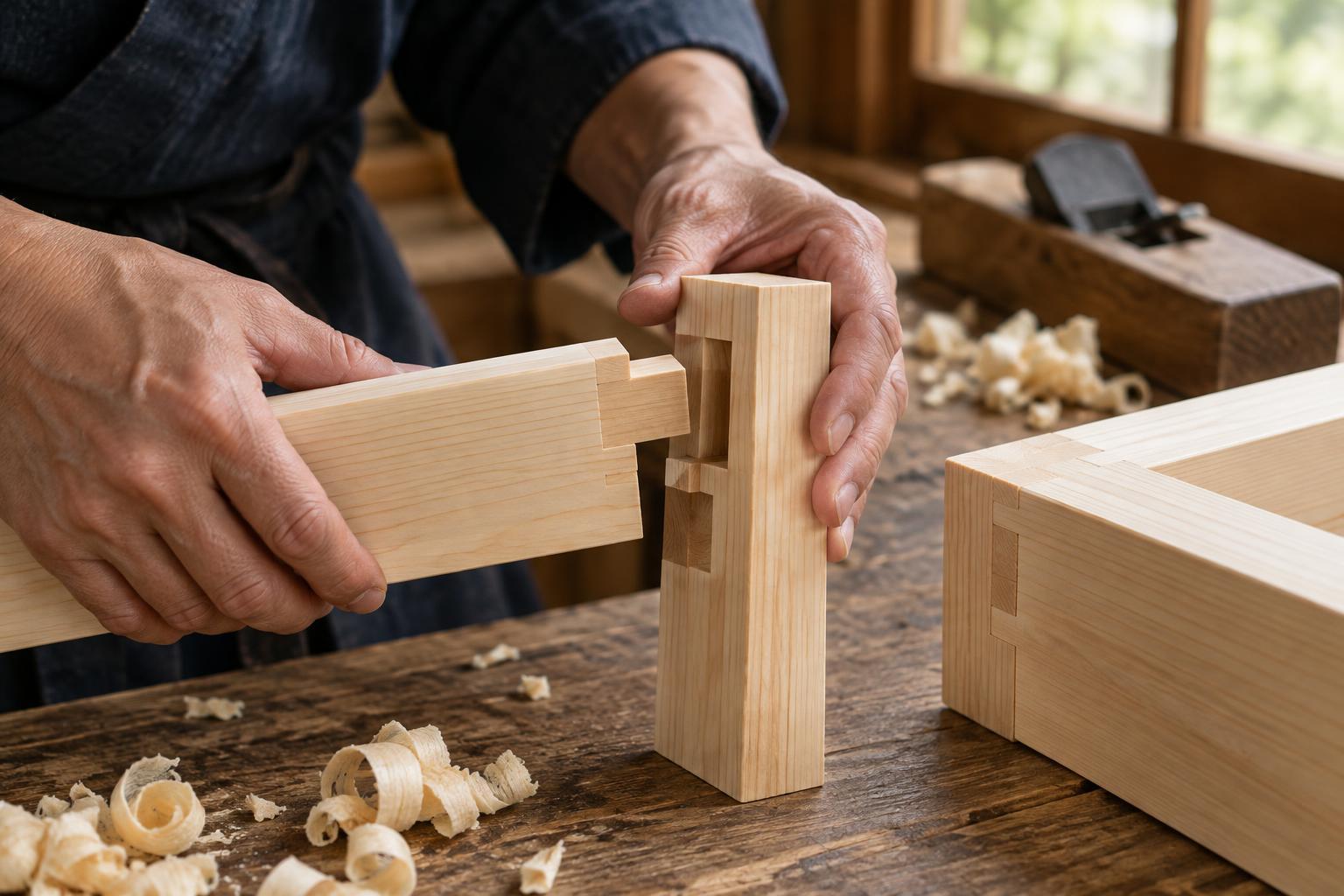
A wooden frame or cabinet with no visible screws can seem almost puzzling. In Japanese joinery, the answer is often inside the connection: one piece of timber is shaped to enter, overlap or interlock with another. The joint may rely on close contact, a shoulder that bears weight, or a wedge or wooden peg that keeps the parts from pulling apart. Its neat exterior is only one part of the design; the hidden surfaces have work to do.
“Japanese wood joinery” covers many practices rather than one universal method. Furniture making, architectural carpentry and the repair of older buildings call for different connections. Not every Japanese wooden object avoids nails, metal fittings or glue, and a joint that suits a small box may be unsuitable for a large structural frame. Looking beyond the absence of visible fasteners reveals the more useful question: what forces must this particular connection resist?
Shape gives a joint its strength
A familiar starting point is the mortise-and-tenon joint. A projecting part of one piece, the tenon, fits into a cavity, the mortise, in another. When properly designed for its purpose, the surrounding wood helps resist sideways movement, while the tenon’s shoulders can provide a broad, stable bearing surface. A peg or wedge may add security. Close fit matters, but strength does not come from friction alone: the way the parts meet determines how a load passes through them.
Other joints solve different problems. A scarf joint joins timber end to end when a longer member is needed; a corner joint brings members together at an angle. Some forms include notches or stepped surfaces that limit movement in a particular direction. Intricate shapes can be impressive, but complexity is not automatically better. A straightforward joint with enough sound wood around it may serve its task more reliably than an elaborate cut made without regard to load or grain.
The grain is part of the plan
Wood is not uniform in every direction. Its fibers generally run along the length of a board or beam, and it responds differently to force across those fibers than along them. A narrow projection cut across unfavorable grain can be vulnerable even if its outline locks neatly into a matching recess. Joinery therefore involves deciding not only where two pieces meet, but how their grain runs through the connection and how much material remains after cutting.
Wood also changes dimension as it gains or loses moisture, usually more across the grain than along its length. A carefully fitted joint cannot stop that natural movement. Makers may choose the orientation and proportions of parts to allow for it, particularly where wide panels meet frames. These decisions are less visible than a dramatic interlocking pattern, yet they can help an object remain useful through ordinary changes in its surroundings.
Precision means more than a tight fit
Traditional joinery is often associated with precise handwork. Layout comes first: a maker establishes reference faces, marks the cut and checks that corresponding surfaces will meet as intended. Saws, chisels and planes can then remove material gradually. The aim is not simply to force two pieces together. An overly tight joint may damage an edge during assembly, while a loose one may shift under use.
Fitting also involves deciding which surfaces need firm contact and which need clearance. A shoulder should sit where it is meant to bear; a wedge needs room to do its job. The order of assembly matters too, especially when several members must come together in one frame. For a beginner, studying a simple mortise and tenon—or making a practice version in scrap wood—can be more revealing than starting with the most intricate joint in a photograph.
How to look at a finished piece
When you encounter Japanese joinery in a building, furnishing or craft object, start with its purpose. Is the connection supporting weight, keeping a panel in place or allowing parts to be assembled and, perhaps, taken apart? Follow the lines of the wood and notice where the pieces change direction. A flush surface may conceal a substantial joint, while a visible peg or wedge may be an intentional part of the solution.
The appeal of this work is not that timber somehow ignores the need for fastening. It is that the fastening can be designed into the timber itself, sometimes with help from a small additional part. Shape, grain, fit and use all contribute. Understanding those principles makes the quiet meeting of two pieces of wood more interesting than a mystery—and leaves room to appreciate the choices behind each particular object.