Start with the strips, not the pattern
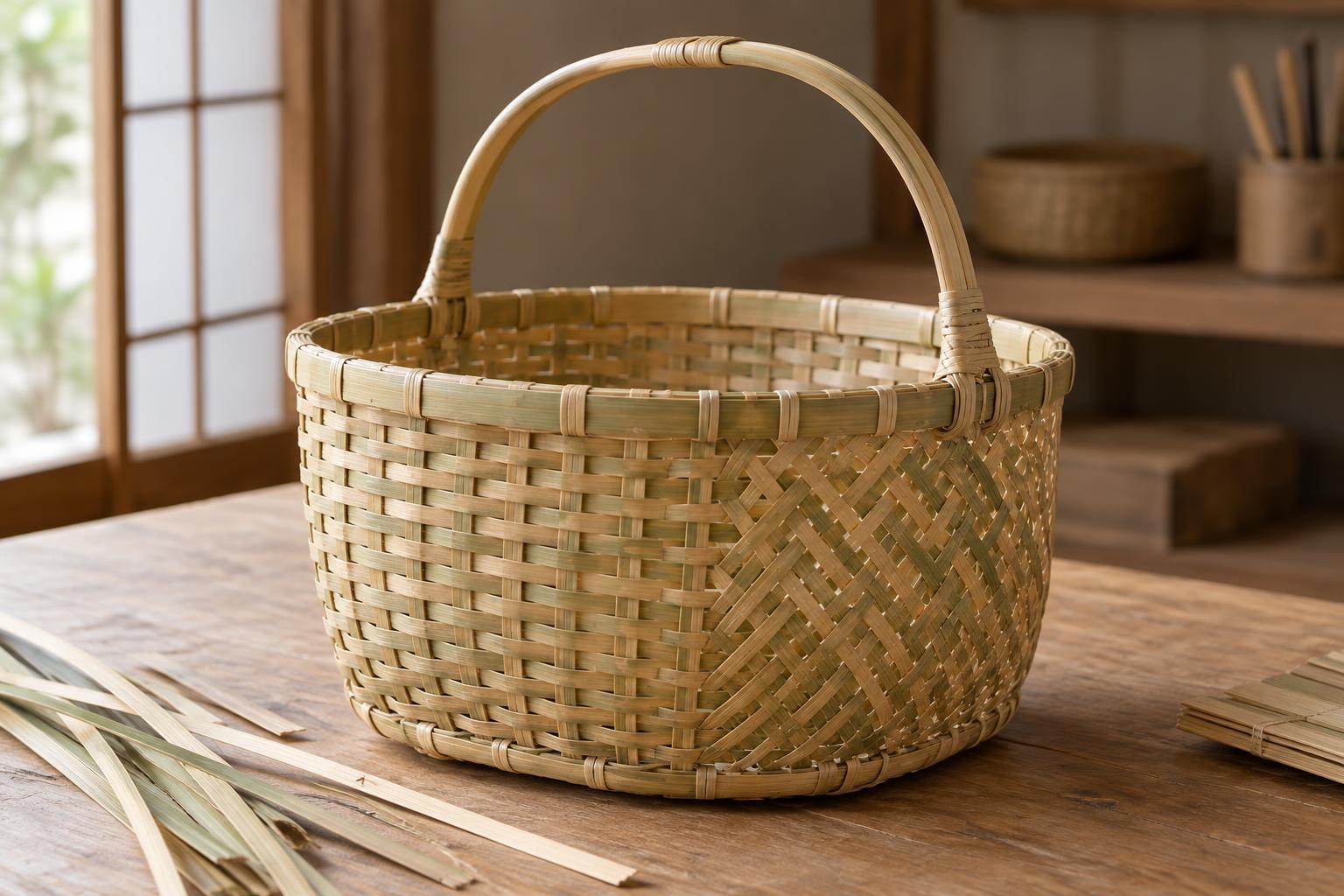
At first glance, a bamboo basket may look like a single repeating pattern. Look closer and you can see decisions about how the bamboo was split, thinned, arranged, and secured. Some strips are broad and flat; others are narrow enough to draw a fine line through the surface. A basket might use both, giving its base a firm structure while leaving its sides light and open.
Japanese bamboo basketry includes everyday containers as well as pieces made for display or flower arrangement. Their intended uses differ, so there is no single test for a good basket. A sturdy storage basket may favor an even base and a comfortable rim. A sculptural basket may use deliberate asymmetry or open spaces. Learning a few weave structures makes it easier to appreciate either kind on its own terms.
Three weave structures to recognize
Plain weave is the most straightforward to follow with your eyes: a strip passes over one crossing strip, then under the next. On the following row, that order alternates, creating a checkerboard effect. Broad strips make the structure easy to see, while fine strips can produce a much denser surface. If the basket changes direction around a corner, watch how the maker maintains the rhythm without leaving an awkward gap.
In twill weave, a strip passes over more than one crossing strip before going under. The crossings shift from row to row, creating diagonal lines across the surface. Those lines may be subtle in a tightly woven basket or prominent in one with contrasting strip widths or colors. Twill is worth viewing from several angles: the diagonals can lead the eye around a curved wall and make the basket’s shape feel especially fluid.
Hexagonal weaving uses strips running in three directions, commonly meeting to form a network of six-sided openings. Its airy appearance can be striking, but the open spaces also reveal the workmanship clearly. Notice whether the openings change gradually as the basket curves or whether the pattern breaks abruptly. Makers may combine structures within one basket, so a hexagonal body can sit above a denser base or beneath a differently woven rim.
Follow the basket from base to rim
Begin at the base, where many of the structural strips meet. If the basket is meant to stand, set it on a level surface and see whether it sits securely. Turn it over if you can do so safely. The underside often shows how the weave began and how the strips were redirected into the walls. Small differences in spacing can be natural in handwork; what matters more is whether the transition looks controlled and suits the form.
Next, follow the strips up the sides. Do they keep an intentional spacing as the basket widens or narrows? Are the curves smooth, or does the basket have purposeful angles? A well-considered shape need not be perfectly symmetrical. Even when a basket leans or twists, its lines can give a sense that the movement was planned rather than forced.
The rim deserves a slow look. It is both a visual finish and a place that may take frequent handling. Some rims are built up with additional bamboo; others are wrapped or bound. Check whether the ends appear neatly contained and whether the rim feels secure without sharp projections. For a basket with a handle, look at its attachments as well as its shape. A beautiful arch is less convincing if its connection to the body feels loose.
Notice surface, finish, and intended use
Bamboo offers more than one visual texture. A strip may show a smooth outer surface or a softer-looking interior, and makers can use those differences as part of the design. Some finished baskets retain a pale, quiet appearance; others have a darker tone or surface treatment. Color alone is not a reliable measure of age or quality. Instead, look at how consistently the surface has been prepared and whether any changes in tone support the overall composition.
If you hope to use a basket, match it to the task. A tightly woven form may be convenient for holding small dry objects, while an open structure can suit larger items or display. Check for snagging edges if it will hold textiles, and avoid assuming that a decorative basket is suitable for food or water. Ask about care when buying a piece, particularly if it has a coating, a liner, or parts made from another material.
Appreciate the whole form
A useful way to look at a finished basket is to step back, then move close. From a distance, notice its silhouette, balance, and relationship between open and solid areas. Up close, trace one strip through the weave and see how it contributes to that larger shape. This shift in perspective turns a complex surface into a series of understandable choices.
Neatness matters, especially where strips join, change direction, or end. Yet the most interesting basket is not always the most uniform one. A slight variation in spacing or an unexpected curve may bring life to the form. Recognizing the weave gives you a starting vocabulary; paying attention to how its structure serves the basket’s purpose lets you see the maker’s decisions more clearly.