One image, several kinds of skill
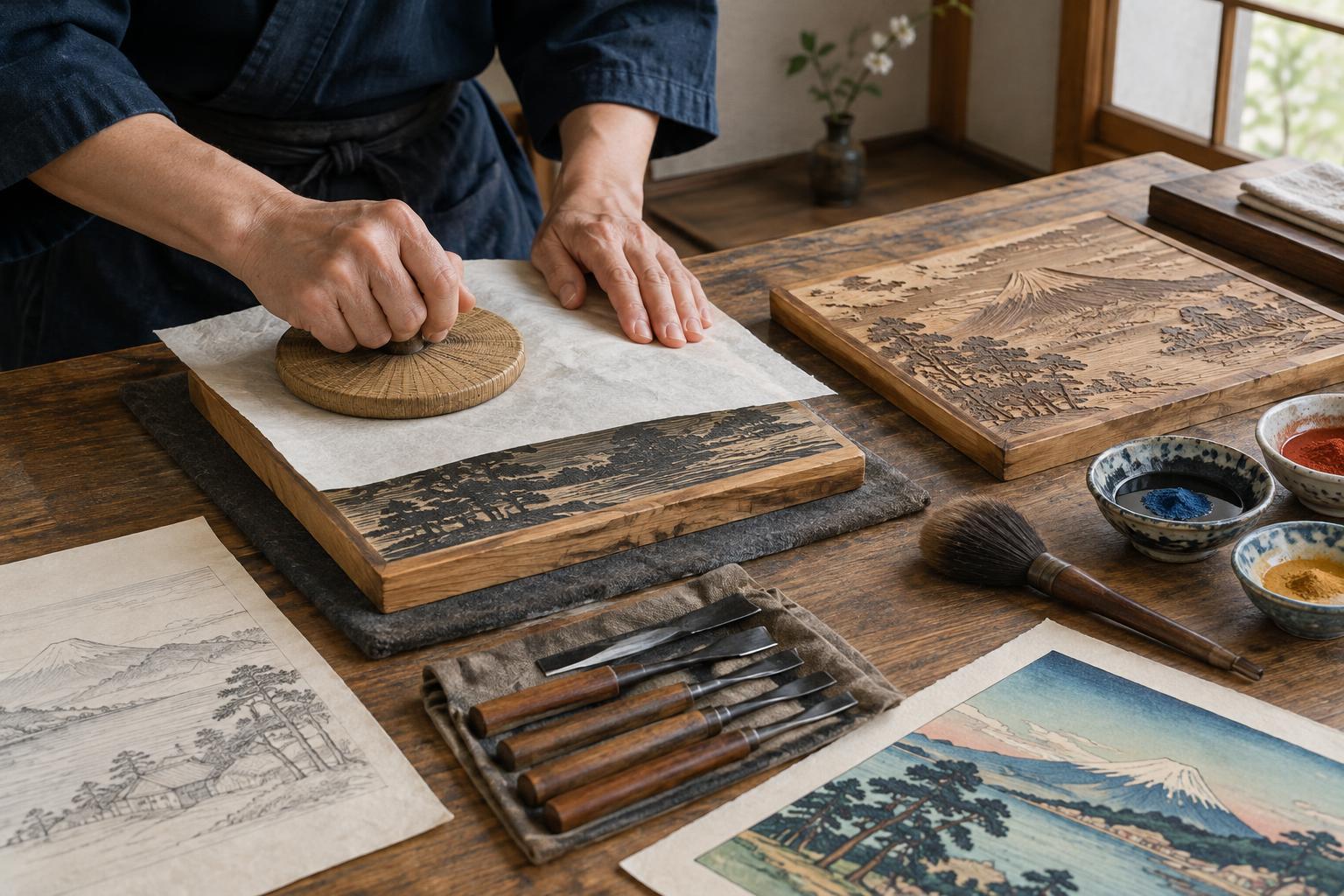
A traditional Japanese woodblock print is often described as a picture made from carved blocks. That is true, but it leaves out the people who turn the design into a print. In the collaborative process associated with ukiyo-e, an artist created the image, a carver cut the blocks, and a printer brought the image onto paper. A publisher might also commission the work, coordinate production and arrange its sale.
These roles were closely connected rather than simply sequential. A fine line had to be possible to carve; a color area had to be practical to print; and the printer’s choices could change the softness or intensity of the finished image. This division of labor is useful to keep in mind when looking at a print: the composition may catch your eye first, but its crisp edges and layered colors reflect other hands as well.
The artist plans the image
The artist establishes the subject, composition, outlines and intended colors. A design might show a landscape, a figure or a small detail of everyday life, but in each case it must eventually be translated into printable shapes. Strong outlines are especially helpful because they give the carver a guide and give later colors a framework.
The design is made with the printing process in mind. Each color needs a place on the page, and areas that overlap must work together when printed in layers. Details such as a patterned garment or a narrow branch call for precision from everyone involved. The artist’s drawing is therefore a starting point, not a complete account of what the final sheet will look like.
The carver turns lines into blocks
The carver transfers the design to wood and cuts away the areas that should not receive ink or pigment. What remains raised will meet the paper. A key block commonly carries the main outlines; separate color blocks supply the larger fields and smaller accents. Because a block prints its image in reverse, the orientation of writing and other directional details must be considered before carving.
Carving is an act of interpretation as well as accuracy. The width of a contour, the taper of a line and the open space around a fine detail all affect how the image reads. The carver also prepares registration guides, often called kentō, so the paper can be placed in a consistent position on each block. Without reliable registration, even beautifully carved colors can drift away from their outlines.
The printer builds the image layer by layer
The printer applies pigment to a block, places a sheet of paper against the registration guides and rubs the back with a baren, a hand-held printing tool. The process is repeated with other blocks to add colors. Traditional Japanese printing commonly uses water-based pigments and absorbent washi paper, which respond to changes in moisture and pressure.
This stage is not a matter of pressing every sheet identically. The printer judges how much pigment and moisture to use and how firmly to rub. A light touch can leave a color airy; a stronger impression can make it more saturated. Gradations, known as bokashi, can create a soft transition within a printed area. Even when the same blocks are used, these decisions may give individual impressions subtle differences.
How to look at a finished print
When viewing a woodblock print, follow an outline to see how steadily it holds a shape, then look at where two colors meet. Notice whether a broad area is even or intentionally graded, and whether a tiny detail remains clear. These observations reveal the conversation between design, carving and printing without requiring you to identify every block.
Not every Japanese woodblock print follows the same production model. Some artists carve and print their own work, while others collaborate with specialists. The artist-carver-printer framework is a helpful way to understand many traditional prints, not a rule for all of them. It also offers a reason to slow down: what appears to be one image is the result of many deliberate choices, made across several stages of work.