Start with the right rice and a clear measure
Japanese short-grain rice cooks into tender grains that hold together without becoming a uniform paste. Look for rice labeled Japanese short-grain or japonica. Some bags sold as “sushi rice” contain the same style of uncooked rice; sushi rice becomes a separate preparation when the cooked grains are seasoned with vinegar. These instructions are for ordinary, unseasoned rice.
Measure the dry rice before washing it, and note which cup you used. A Japanese rice-cooker cup holds about 180 milliliters, while a standard US measuring cup holds about 240 milliliters. They are not interchangeable when following a recipe. If your rice cooker has water lines, use its supplied cup and fill to the matching line after washing and draining the rice. For a stovetop pot, a useful starting point is about 1.1 to 1.2 measures of water for each measure of dry rice. You can adjust next time to suit your rice and preferred texture.
Wash gently, then drain
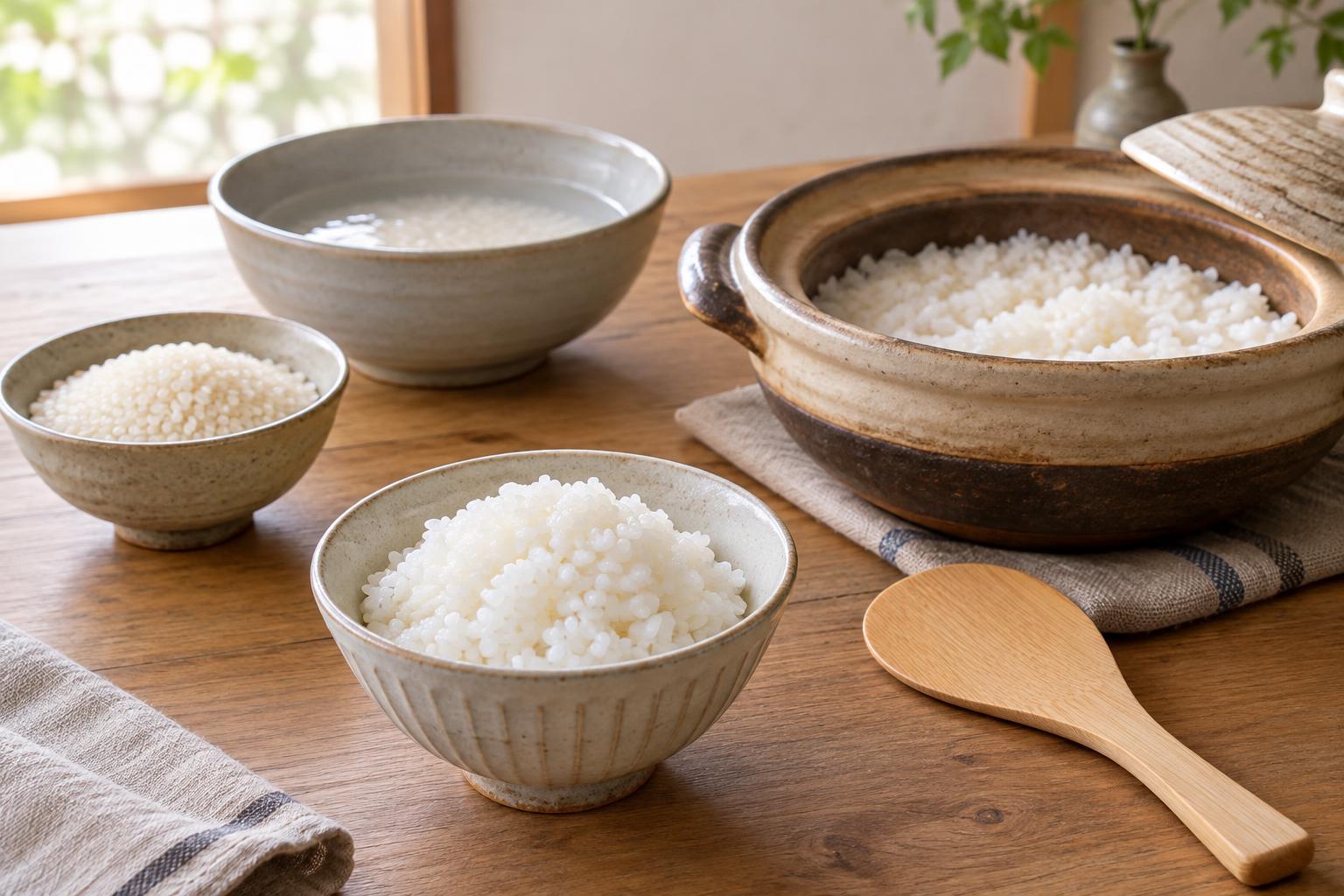
Put the measured rice in a bowl and add plenty of cool water. Swirl the grains gently with your hand, then pour off the cloudy water promptly. Add fresh water, move the rice through it a few more times and drain again. Repeat until the water looks less cloudy. It does not need to run perfectly clear: some cloudiness is normal.
Washing removes loose surface starch and any fine debris, helping the cooked grains feel distinct while still clinging pleasantly together. There is no need to scrub hard, which can break the grains. A fine-mesh sieve makes draining easier, but avoid pressing the rice against it. Once washed, let the rice drain briefly so that excess rinse water does not make your measured cooking water less predictable.
Cook in a rice cooker or on the stove
For a rice cooker, transfer the drained rice to the inner pot, add water to the appropriate line and select the usual white-rice setting. Follow your machine’s guidance on soaking: some cycles include that time automatically. If yours does not, a soak of roughly 20 to 30 minutes before cooking can help the grains hydrate evenly, especially when the water is cold. This step is helpful rather than an absolute requirement.
For a stovetop batch, choose a pot with a well-fitting lid. Add the washed, drained rice and measured water. As a starting example, one standard US cup of dry rice can be cooked with about 265 to 290 milliliters of water. If time allows, let it soak in that water for 20 to 30 minutes. Cover the pot, bring it to a boil over medium heat, then reduce the heat to low. Cook gently for about 12 to 15 minutes, or until the water has been absorbed. Keep the lid on so steam stays inside.
Turn off the heat and leave the covered pot undisturbed for another 10 to 15 minutes. This rest helps moisture settle through the rice. Stove settings, pot thickness and rice varieties differ, so treat the amounts and times as a starting method, not a guarantee. If the rice is too firm, try a little more water next time; if it is overly soft, try a little less.
Fluff and serve while warm
After the rest, open the lid and use a rice paddle or broad spoon to lift and turn the rice gently. Rather than stirring in circles, cut down through the rice and fold sections over. This releases excess steam without crushing the grains. Serve it warm in individual bowls, alongside dishes that offer contrasting flavors and textures, such as vegetables, fish, tofu, pickles or soup.
Plain rice is worth tasting before adding anything to it. Its mild sweetness and soft texture are part of its appeal, and it provides a calm counterpart to more strongly seasoned foods. For a simple bowl, spoon in a modest portion and avoid packing it down. If you are making onigiri or another shaped preparation, the rice should be warm enough to hold together but comfortable to handle.
Keep leftovers pleasant to eat
Rice is at its best soon after cooking, but leftovers need not go to waste. Divide extra rice into portions, let the steam escape briefly and refrigerate or freeze it promptly rather than leaving it at room temperature for an extended period. Reheat until thoroughly hot, adding a few drops of water and covering it to bring back some softness. Refrigerated rice often becomes firm; freezing individual portions soon after cooking can preserve a more tender texture.
After a few batches, you will know whether your preferred bowl is slightly firmer or softer. Keep the rice measure, pot and washing method consistent while adjusting the water by small amounts. That simple habit makes it easier to find a reliable everyday result.