Start with a polite opening
You do not need fluent Japanese to make a thoughtful request. A few short phrases, spoken calmly and paired with attention to the other person’s response, can help you navigate shops, stations, museums and small restaurants. The romanized pronunciations below are guides rather than exact representations of spoken Japanese; showing the written phrase on your phone can also help.
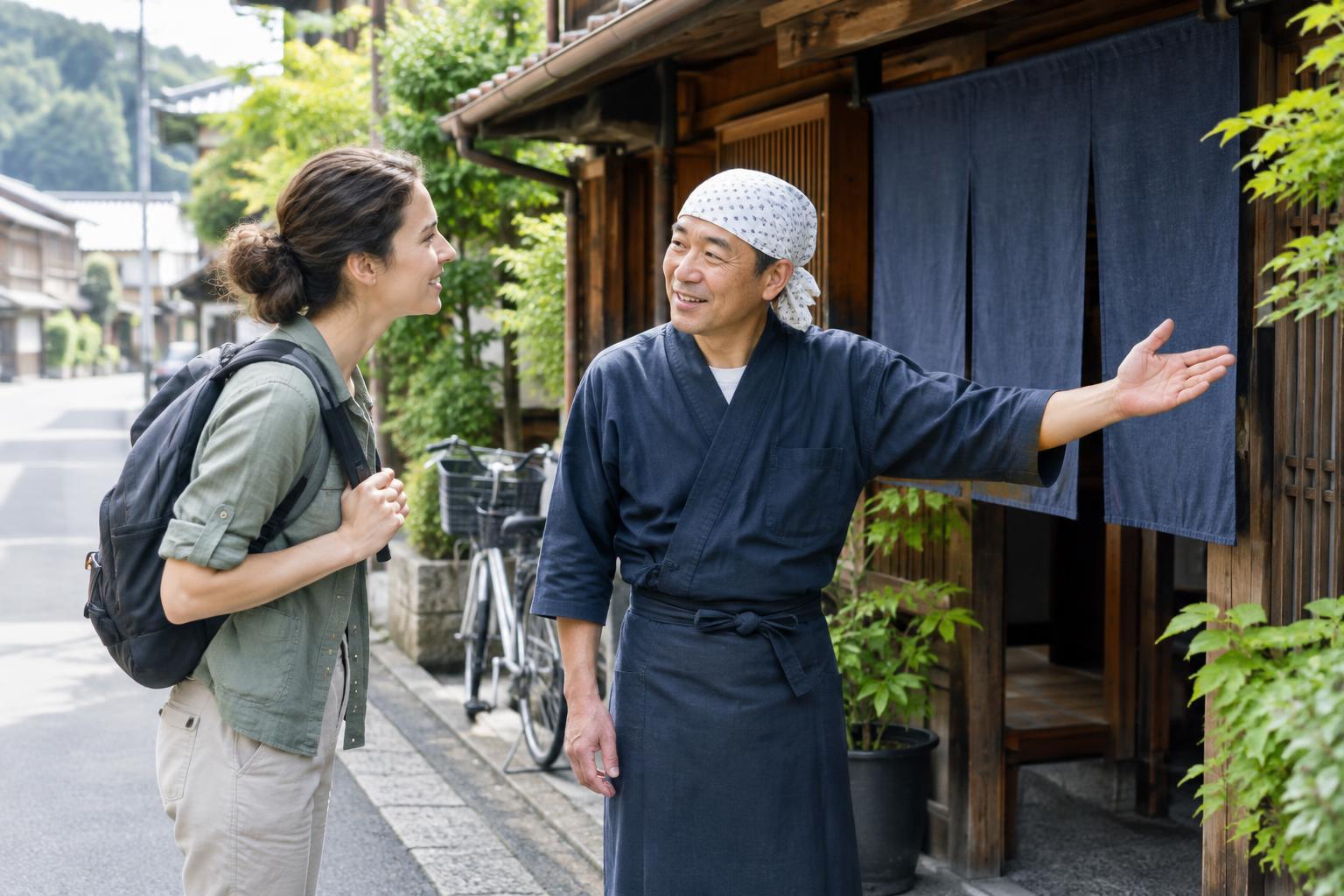
Sumimasen (すみません) is a useful way to get someone’s attention. It can mean “excuse me” and is also used to apologize or express appreciation in some situations. Try saying it before a question rather than calling out from a distance. Onegaishimasu (お願いします), meaning roughly “please,” is handy when making a request. Neither phrase guarantees that someone has time to help, so be ready to accept a brief answer and move on.
Ask for help finding your way
For a direct question, try Toire wa doko desu ka? (トイレはどこですか?), “Where is the restroom?” You can replace toire with eki (station) to ask where the station is. If you have a destination written on a map or ticket, pointing to it while asking Michi o oshiete itadakemasu ka? (道を教えていただけますか?), “Could you tell me the way?”, gives the other person something concrete to work with.
When you need more general assistance, Tetsudatte itadakemasu ka? (手伝っていただけますか?) means “Could you help me?” Keep the request specific if you can: show the address, ticket or sign you are asking about. At a busy counter or station, it is often easier for someone to answer a focused question than to solve an entire travel plan. If you need a different language, Eigo ga hanasemasu ka? (英語が話せますか?) asks, “Can you speak English?” Ask without assuming the answer will be yes.
Check before entering, sitting or taking photos
Rules can vary between venues, and a quiet space may have expectations that are not obvious from the doorway. To ask whether you may enter, say Koko wa haitte mo ii desu ka? (ここは入ってもいいですか?), “May I enter here?” For a seat, Koko ni suwatte mo ii desu ka? (ここに座ってもいいですか?) means “May I sit here?” A sign or a staff member’s gesture may answer more clearly than a spoken explanation.
Photography is worth checking rather than assuming. Koko de shashin o totte mo ii desu ka? (ここで写真を撮ってもいいですか?) asks, “May I take photos here?” Permission to photograph a room does not necessarily include people, artworks or every part of a venue. If the answer is no, put the camera away without pressing for an exception. At an entrance where footwear is unclear, Kutsu o nugimasu ka? (靴を脱ぎますか?) asks whether you should take off your shoes.
Make room for clarification
An answer may come faster than you can follow. Wakarimasen (わかりません) means “I don’t understand.” Mou ichido onegaishimasu (もう一度お願いします) asks for it “one more time, please,” while Yukkuri onegaishimasu (ゆっくりお願いします) requests a slower pace. You can use these phrases together, then look for a sign, number or landmark that confirms what you heard.
Listen and watch for the response rather than relying on a single familiar word. Hai (はい) generally means “yes,” but people may use it to acknowledge that they heard you, not necessarily to grant permission. If you remain unsure whether an action is allowed, pause and check a posted rule or ask a staff member. Translation apps can help with longer explanations, especially if you let the other person read the screen instead of playing audio in a quiet space.
Thank people and keep the exchange simple
Arigatou gozaimasu (ありがとうございます) is a polite “thank you” that works in many everyday encounters. Say it after receiving directions, help with a ticket or an answer to a question. If you have interrupted someone or they have gone out of their way, a small nod and a sincere thanks are enough; you do not need an elaborate speech.
Consider saving your most useful phrases in a note alongside your destination’s name and address in Japanese. That way, you can ask, point and confirm without putting pressure on a stranger to understand every word. The aim is not perfect pronunciation. It is to make your request clear, respect the answer and leave the interaction as pleasantly as it began.