What does kiriko mean?
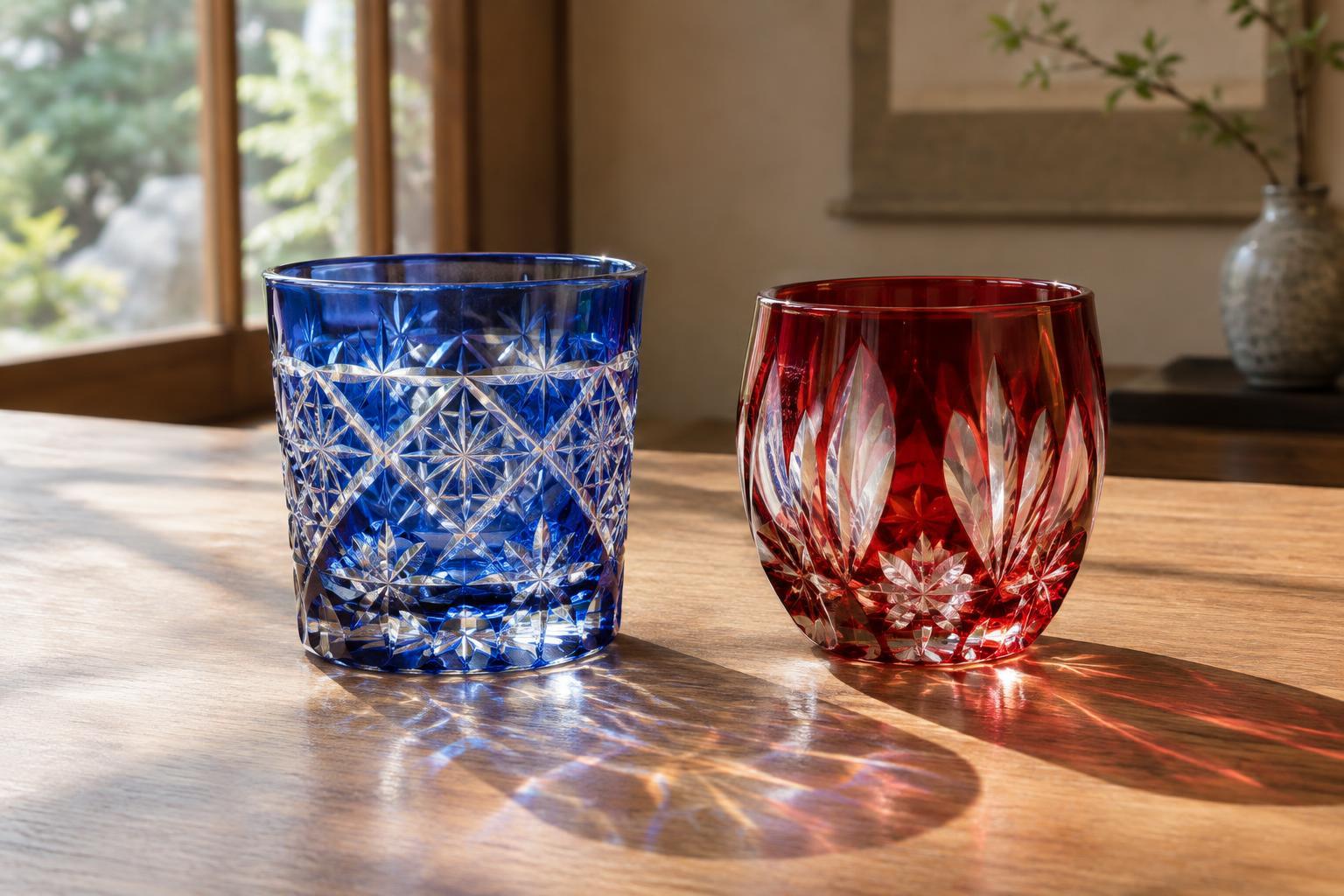
Kiriko refers to cut glass: a maker grinds patterns into a glass surface, then finishes the cuts to shape the way light moves through it. On a colored piece, cutting may expose clear glass beneath the color. A simple cup can therefore look different when it is empty, filled, turned in the hand or placed near a window.
Edo kiriko and Satsuma kiriko are two well-known Japanese approaches to this craft. Their names point to different places and histories: Edo is the former name of Tokyo, while Satsuma refers to a historical domain centered in what is now Kagoshima Prefecture. Both traditions include varied work, so it helps to treat their familiar characteristics as guides to looking, not rules that every piece must follow.
Two histories, two starting points
Edo kiriko developed in the Edo area during the nineteenth century. Early cut-glass work included clear glass; colored glass later became an important part of the tradition’s visual vocabulary. Today, many people recognize Edo kiriko by its carefully repeated geometric patterns and the lively contrast between colored and clear areas.
Satsuma kiriko also took shape in the nineteenth century, through glassmaking encouraged by the Satsuma domain. Its early production did not continue uninterrupted, and later makers revived the craft. That history is worth remembering when looking at a contemporary piece: it can represent both a historical design language and the skill of people working with it now.
Neither tradition is a single pattern handed down unchanged. Makers may draw on established motifs while adjusting the scale of a cut, the weight of a vessel or the balance of color and clear glass.
How the cuts handle color and light
A useful way to compare the two is to look at the edge where color meets a cut. In many examples of Edo kiriko, a relatively thin colored layer sits over clear glass. Cutting through it creates a distinct line between the colored surface and the exposed glass. Repeated facets can make a pattern feel precise and rhythmic, especially when the vessel is turned under light.
Satsuma kiriko is often associated with a thicker colored layer. As a cut moves through that layer, color may shift gradually toward clear glass rather than ending at a sharply defined boundary. This soft transition is often called bokashi, or gradation. Alongside the depth of the glass, it can give a piece a gentler, more shaded appearance.
These are tendencies, not a test for identifying every object. Clear Edo kiriko exists, and individual makers make different choices about color and cutting. To appreciate a piece, look beyond its label: notice whether its lines seem crisp or softly shaded, how deeply the cuts enter the glass, and whether the pattern feels dense or leaves room for the uncut surface.
Choosing a piece for everyday life
If you are considering a cup or small dish, begin with its intended use. Hold it if you can. A heavier vessel may feel satisfying for slow sipping, while a lighter one may be more comfortable for frequent handling. Check the rim, base and balance, and imagine how easily you can wash and store it. A pattern you enjoy from across the room may reveal even more when you look through it at close range.
Ask the seller who made the piece and where it was produced, particularly if its connection to a named tradition matters to you. Price, color and apparent complexity alone cannot establish provenance. A clear description of the maker and process is more useful than assuming that one visible feature proves a piece is Edo or Satsuma kiriko.
For care, follow any guidance supplied by the maker. When in doubt, gentle hand-washing with mild soap and a soft sponge is a cautious choice; avoid abrasive cleaners and sudden temperature changes. Dry the glass with a soft cloth before putting it away. Whether displayed on a shelf or brought out for a drink, cut glass rewards a little time spent watching how its surfaces catch the light.