Start with the route, not the station map
Before entering a station, note four things about your journey: the line or operator, your destination station, the direction of travel and any transfer station. Keep the destination written in both English and Japanese if you can. Many stations display English alongside Japanese, but a written station name is useful when asking for help or comparing similar-looking signs. A route suggestion may also specify a service type, such as local or express; keep that detail handy.
A large station may serve several railway companies as well as multiple lines run by the same company. Its entrances can lead to different ticket gates, and the shortest walk on a map may not be the simplest route inside. Look first for overhead signs naming your line or operator. Once you reach its ticket gates, follow signs toward the platform. If you are unsure, pause beside the flow of pedestrians rather than stopping in a narrow passage.
Read signs as a sequence of decisions
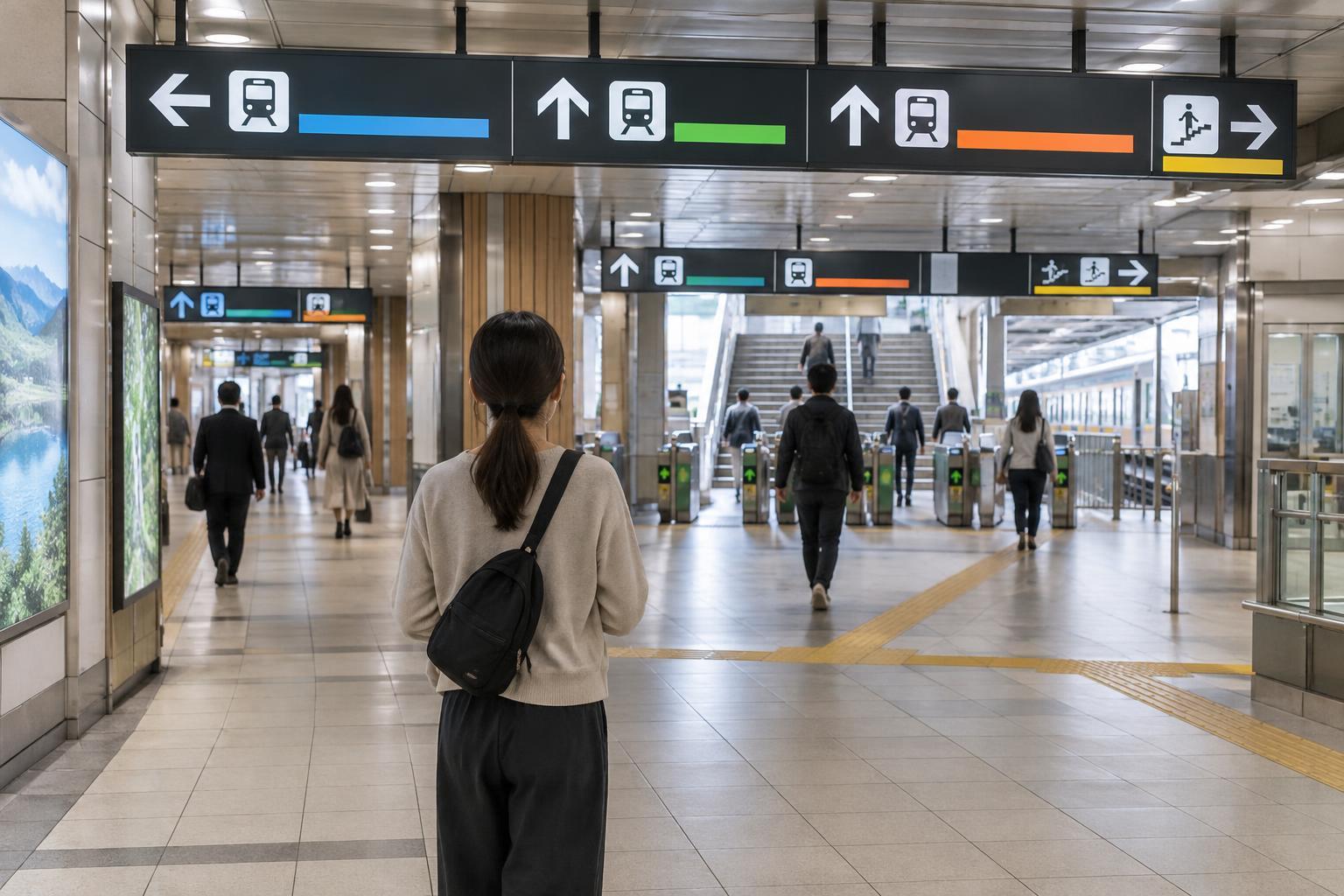
Station signs are easier to use when you treat them as a series of small decisions: line, gates, platform, train and exit. Line names are often paired with a color and symbol; some networks also use station numbers. These visual cues can help when names are unfamiliar, although colors and numbering systems are not consistent across every operator. Match more than one detail whenever possible, especially at a station served by several lines.
Arrows usually point toward a passage, staircase or gate rather than directly toward a train. At a junction, read the next sign before continuing. Information boards near ticket gates and platforms may list the next stops or show a route diagram. If a sign seems to conflict with your plan, check whether it refers to the opposite direction, a different operator or a different type of service.
Check the platform and the train separately
Reaching the right platform does not always mean that the next train is yours. Some platforms serve multiple destinations or service types. Check the platform number against your route, then look at the electronic display or train signage for its destination and whether it is local, rapid or express. Stopping patterns vary by line, so an express train may pass your station. When in doubt, a local train is often easier to verify, though it may take longer.
On the platform, use floor markings and signs to find the boarding queue. Some services show car positions or indicate where to wait for a particular train. Let passengers leave before boarding, and keep bags clear of doors and walkways. If you discover that you are waiting on the wrong side, return to the signs for your line and direction rather than assuming the opposite platform is always correct.
Approach transfers one sign at a time
At a transfer station, remain alert for signs bearing the name, color or symbol of your next line. A transfer may be a short walk across a platform or a longer route through corridors and stairs. You may need to pass through a ticket gate, particularly when changing operators; in other cases, the transfer stays within the gated area. Follow the posted route rather than treating every gate as an exit.
Allow extra time when planning a connection through a large or unfamiliar station, especially if you have luggage or need a lift. Direction signs can be more useful than a phone map in underground passages, where your location may be hard to pinpoint. If you lose the trail, look for a station map or ask staff for the next line by name. You need not solve the entire transfer at once: finding the next clearly marked junction is enough.
Choose your exit before leaving the gates
Your destination station is only part of the arrival. Major stations can have many exits, sometimes on opposite sides of broad roads or large building complexes. Check your destination’s address, a nearby landmark or its recommended exit before you leave the platform area. Station maps often show numbered or named exits and nearby streets. Follow exit signs until you reach a map or sign that confirms which route brings you closest.
If the suggested exit involves stairs, look for signs to a lift or an accessible route; it may lead to a different street-level entrance. Once outside, take a moment to orient yourself before walking away from the station. If you emerge at the wrong exit, it is usually more helpful to check the street map than to retrace every step underground. With each trip, the pattern becomes more familiar: identify the line, confirm the train, follow the transfer signs and finish by choosing the exit.